UID726641
威望0
金钱4132
交易诚信度0
主题1
帖子82
注册时间2010-9-11
最后登录2011-12-13
新手上路

交易诚信度0
注册时间2010-9-11
|
原帖由 Northenlight 于 2011-4-1 03:31 发表 
看似有一定道理,其实楼主还是没有明白jitter到底对DA产生音频型号有什么影响。在时钟上确实只是微小的抖动,但通过DA,最后对模拟音频有什么影响?DA是个完全非线性的转换。我这里给你一个链接,虽然是全英文,不过你 ...
真正有心回楼主的帖没有几个,Northenlight 算其中一个,
那个第2张图换成失真能有多大,能否转换成一个具体的数值?不要主观感觉哦。
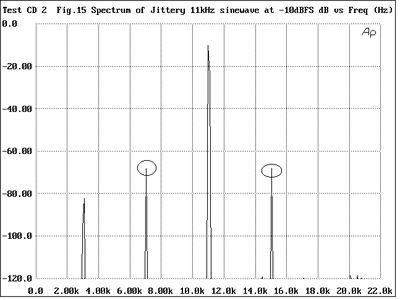
stereophile test CD2中26曲是一个模拟10ns p-p的jitter的结果(刚好就是楼主说的10ns,巧),他们的说明如下:
A different kind of distortion is that occurring in the digital domain due to timing uncertainty in the datastream. "Bits is bits," say many engineers, but they're really only correct when those bits occur at precisely defined intervals. Any regularly occurring timing imprecision in the digital data words will result in spurious tones appearing in the signal when it is finally converted to analog (see Stereophile, May 1990, pp.49-55 and 81-85; December 1990, p.179; and October 1991, pp.63-69). The effect is worse at high levels and at higher frequencies. To demonstrate this, track 26 offers first a pure tone at 11kHz—Warning: don't play this track too loud—followed by the same tone with the effect of the data words representing the tone being jittered at a frequency of 4kHz (figs.14 & 15, respectively) (footnote 9). Each data word should be precisely spaced at 22µs (0.000022s) intervals; the uncertainly in the data word timing is 10ns (0.00000001s) peak-peak. This is a little higher than that encountered in typical CD players, but it has been exaggerated to make the effect clearly audible. In real life, too, the jitter uncertainty would not necessarily be a pure tone, but a mixture of tones as well as noise and hum. Nevertheless, we hope that you can hear the roughness in the decoded sound of the tone due to a purely digital phenomenon. (If the two halves of track 26 sound identical, then it is likely that the difference is being obscured by high levels of jitter in your player and/or processor.)
一般而言jitter对模拟输出的高频的影响会大些,10ns p-p的jitter比一般的CD机要高,但用模拟这么大的jitter 是为了让这个效应容易被耳朵分辨。具体来说,由于这个10ns p-p jitter产生的干扰如下图中7k和15k的成分,还包括3k的第2边带:
我还记得有其他的文章提到jitter对模拟输出信号的调制的,一下找不到了,希望有兴趣的朋友放上来看看。另外大家可以找来听听看是有否可闻差异,反正我是容易分辨的。
对于楼主提出的头部晃动引起的问题,我也粗略估计了一下,设喇叭发出频率同样为Stereophile用的11kHz信号,声速为平常的342m/s,观察者头部摇晃的速度为3mm/s(接近一般的头部微微晃动),这样当头部向喇叭方向靠近的瞬间,观察到的频率为:F'=11000*(342+0.003)/342=11000.0965Hz,而头部向喇叭方向远离的瞬间,观察到的频率为F'=11000*(342-0.003)/342=10999.9035Hz, 这两个频率和原频率相比应该是几乎没有变化,甚至用频谱分析仪只能看到了谱线稍微变宽(甚至还看不到)。至于这两个频谱的幅度,一下还没有时间仔细算(要查好多书,呵呵),最好楼主能有实际的计算结果或者分析,而不是流入简单的判断之中。 |
|
 楼主: Dracula81
 [复制链接]


 京公网安备 11010602010207号
( 京ICP证041102号,京ICP备09075138号-9 )
京公网安备 11010602010207号
( 京ICP证041102号,京ICP备09075138号-9 )













 狗仔卡
狗仔卡
 发表于 2011-4-1 02:03










 楼主
楼主

