UID28476
威望48
金钱121864
交易诚信度0
主题16
帖子689
注册时间2003-1-1
最后登录2025-12-31
特级会员

交易诚信度0
注册时间2003-1-1
|
粗略的看一了一下,发现很多人不相信,外媒对中国十分不友好,而且说要举例,那我举几个吧,不用费劲找都,直接搜CHINA然后随便点都是这种东西
FROM CNN(你要说CNN不是具有代表性的外媒,我没话说)
Pollution, Internet, doping dominate Olympics lead-up
BEIJING, China (CNN) -- On the last weekend before theOlympic Games begin in Beijing, Olympic officials were still wrestlingwith pollution problems, Internet access, and at least one doping case-- albeit an old one.
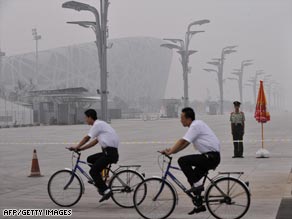 Cyclists pass the National Stadium known as the 'Bird's Nest' seen through thick smog in Beijing. Cyclists pass the National Stadium known as the 'Bird's Nest' seen through thick smog in Beijing.

1 of 2

more photos »

InternationalOlympic Committee spokeswoman Giselle Davies told a news conferencethat plans are in place to be able to move events in time if airquality becomes a problem. She said Beijing Olympic organizers andChinese environment authorities are providing the IOC with dailyupdates about pollution and weather, which can both have an effect onair quality.
"The two are pretty intrinsically linked," Daviestold a news conference. "We've seen in past days that some of the badskies were actually as much due to an amount of humidity in the air asanything else."
Chinese officials last month implemented adrastic plan to combat Beijing's persistent pollution problems, takinghalf of the city's more than 3 million vehicles off the road,temporarily closing factories and chemical plants, and suspending allconstruction work.
Chinese authorities have said they'reconfident they can reduce pollution levels but athletes will still haveto compete in less-than-healthy air, which can hurt performance.  Watch more about Beijing's smog problem » Watch more about Beijing's smog problem »
The capital and surrounding areas of northeastern China have the world's worst nitrogen dioxide levels, according to satellite images taken by the European Space Agency in 2005.
The U.S. Environmental Protection Agency says the chemical can causeeye, nose, and throat irritation. It may also cause impaired lungfunction and increased respiratory infections.
Most days, Beijing is a city shrouded in gray.  See photos of the smoggy cityscape » See photos of the smoggy cityscape »
Another issue of concern is press freedom after journalists this weekdiscovered some Web sites were unavailable. A spokesman for the BeijingOlympicshas said if some sites won't load it's because they have spread contentbanned by Chinese laws, not because officials are restricting theactivities of the media.
The spokesman, Sun Weide, pointed out that new Chinese laws andregulations have eased restrictions on journalists. They includefilming access in Tiananmen Square, simplified customs requirements fornewsgathering equipment, and a "zero-refusal policy" for interviewrequests with Beijing Olympics officials, he said.
Sun said China would allow "sufficient convenience" on the Internet to allow journalists to do their jobs.
Davies said theIOChas had numerous meetings with Chinese Olympic officials andauthorities about the issue, and the Chinese have promised the fullestInternet access possible for journalists.
"We can only welcome the openness and transparency moves made this week and encourage that that can continue," Davies said.
The IOC said this week it has made no deal about Internet censorship with Chinese authorities.
Davies also said the IOC Executive Board, which met Saturday for itslast meeting before the Games, stripped the U.S. men's 1,600-meterrelay team of the gold medals it won at the 2000 Sydney Olympics afteran admission by team member Antonio Pettigrew that he had usedperformance-enhancing drugs.
The IOC ruled Pettigrew, whoreturned his medal in June, is now ineligible to compete in Beijing andit did not rule out further sanctions against him.

Board members will decide later how to reallocate the Sydney medals and diplomas, the IOC said.
"Doping is a serious threat to the integrity of sport," an IOCstatement said. "Mr. Pettigrew's case illustrates that, by choosing todope, an athlete also jeopardizes his own and his teammates'achievements.
FROM REUTERS (同样的如果你认为REUTERS不是西方具有代表性的媒体我也没法)
Cuba denies athlete signed China rights plea
By Andrew Cawthorne
BEIJING (Reuters) - A senior Cuban athletics coach denied on Monday that his team's best hope for a track gold at the Beijing Olympics had signed a controversial petition pressing China over Tibet and human rights.
Last week, rights groups published a petition they said was signedby 40 athletes, including Cuba's 110 meter world record holder DayronRobles, urging Chinese President Hu Jintao to find peace in Tibet andprotect freedom of religion and opinion.
The appearance of Robles's name was a surprise given close ties between Cuba and China, which are both Communist-run.
Cuban athletes generally avoid touchy politics, with the exception of defectors from the state-run sports system.
"We saw this when we arrived, but at no time did anyone approach us,nor did we sign anything like this. We don't even know who that groupis," Robles's coach Santiago Antunez said of German-based Sports forPeace that put the petition online.
"It's wrong. We're just here to compete," Antunez added as his21-year-old protege limbered up behind him on a training track where hewas not available for interviews.
Antunez, whose own country is a frequent target of rights criticismover freedom of expression and movement, said nations should respecteach other's politics.
"It's not up to us (sportsmen) to talk," he said. Continued...
China rapped for "stone face"; IOC urges smiles
OSLO (Reuters) - Chinese police and military are frighteningtourists with a "stone face" at the Beijing games and should smilemore, a senior International Olympic Committee (IOC) member was quotedas saying on Monday.
Norwegian Gerhard Heiberg, chairman of the IOC's marketingcommission, said he had taken the matter up with Chinese officials andurged a happier and more welcoming attitude.
"We think that in particular the military and police can behave in adifferent manner," Heiberg told the Norwegian daily Aftenposten. "Theylook like stone faces."
"The Chinese are scaring the wits out of foreigners. We can't haveit like this," said Heiberg. "When, in addition, they have weapons andlook scary, it is even worse."
(Reporting by John Acher)
frome cbc
China's economic miracle: the high price of progress
CBC News Online | April 20, 2006
Everywhere you turn these days China is being heralded as the next bigthing. There's no question the country is on the rise -- witness thestunning economic growth, massive modernization programs and the risingstandard of living in the cities.
But the upsides come with downsides. The growing gap between rich andpoor, unrest in the countryside, persistant government corruption, andstaggering environmental challenges -- all threaten to derail thecountry's dreams.
China's present status as a world economic power comes only after a long and often painful journey.
A brief history
A succession of dynasties ruled China from the second millennium BC tothe early 1900s. Chinese history changed course, however, as Europeansexpanded into Asia.
China suffered through clashes with European powers in the 1800s. Then,in 1911, Chinese revolutionaries overthrew the last dynasty. Thecountry suffered internal strife for nearly four decades due towarlords, civil war and Japanese invasion. In 1949, the ChineseCommunist party won the civil war and established China's currentgovernment.
The Communists implemented many social and political changes, startingin the 1950s with the transition to a planned economy. Leader MaoZedong launched a "Cultural Revolution," in which young loyalistsattacked intellectuals and party leaders.
In the late 1970s, the Chinese government introduced economic reforms,introducing elements of a free-market economy. The government alsoencouraged foreign investment. That laid the groundwork for the modernChina we see today.
The "economic miracle"
China's economic engine has really been in overdrive for much of thelast two decades – the payoff of the 1978 decision by Deng Xiaoping toadopt free-market reforms. But it's only in recent years that thepublic at large has taken notice. The China story has simply become sobig that it's impossible to escape.
Its GDP is growing by 10 per cent a year. Industrial production isgalloping ahead at an annual rate of 17 per cent. Its economy is nowthe second-biggest in the world, behind only the U.S., and there arepredictions it will assume the top spot as early as 2020.
China's integration into the world economy has been astonishinglyrapid. Since its adoption of the "Four Modernizations" a generation ago(agriculture, industry, science and technology, and defence) China'sshare of world economic output has grown from 3.4 per cent to almost 12per cent in 2000.
Its admission into the World Trade Organization in late 2001 has onlyserved to accelerate that growth. The World Bank now estimates thatexports represent a quarter of China's GDP, five times the level of1978.
And it's not just exports that are booming. China is consuming andimporting at a frantic rate. Global trade was moribund in 2003, butChina managed to boost its imports by 40 per cent that year. It is nowthe world's biggest consumer of copper and aluminum as its appetite forimports of raw materials shows no sign of easing any time soon.
China's economic transformation has helped to create a large middleclass. Wages have risen, but still remain well below those in the restof the industrialized world – a fact that has kept Chinese goodscompetitively priced and allowed China to make major inroads intomarkets where they were formerly bit players.
Struggling with problems
CURRENT POPULATION OF CHINA:
| 1.3 billion
| POPULATION IF CHINA HAD NOT INSTITUTED ONE-CHILD POLICY IN 1978:
| 1.5 billion
Source: Government of China |
China's explosive growth has come at a price. Theeconomic gains have not been shared equally. Millions have becomericher. But hundreds of millions have not. More than 60 per cent of thepopulation still toils in agriculture; the country's "economic miracle"has yet to make an appearance in much of the country. Corruption alsoremains well entrenched.
The so-called "Iron Rice Bowl" has become one of the casualties ofChina's transition to a market economy. Where central planning onceguaranteed lifetime employment for everyone in the work unit, the oldguarantees are now gone.Millions of workers have lost their jobs in the restructuring, prompting frequent protests.
The concept of sustainable development has proven to be a fleeting goalin China. Environmental concerns take a distant back seat to growth.Air pollution is among the worst in the world. The World Bank estimatesthat 16 of the world's 20 most-polluted cities are in China – falloutfrom the country's heavy use of coal-fired generating stations. Anyonewho's been to Beijing can attest to the perpetual haze that hangs overthe city – a problem its leaders know they must address before the cityhosts the Summer Olympics in 2008.
The steady growth of its military remains a worry in the region andglobally, as does its growing insistence on blocking Taiwan'sindependence aspirations. Human rights exist on paper only; dissidentscontinue to languish in jail. China leads the world in executions.
The 1989 crackdown in Beijing's Tiananmen Square may have attractedworld condemnation. But China's Communist leadership offered noapologies. Since then, there has been no substantial liberalization inChina's political structure. Despite the odd release of a dissident ortwo, official tolerance for differing views remains low.
Its one-child policy has led to accusations of forced abortions and a distinct shortage of girl babies.
POPULATION OF SHANGHAI:
| 12.8 Million
| RANK OF SHANGHAI AMONG WORLD'S MOST POPULOUS CITIES:
| 1st
Source: World Gazetteer |
Things aren't all bleak, to be sure. China's fashion,arts and cultural community has enjoyed somewhat of a renaissance oflate. You no longer see the Mao suits that once dominated urbanstreetscapes. Chinese artists, with some exceptions, are enjoyingunprecedented freedoms. Chinese authorities, again with someexceptions, are even allowing their citizens to access the internet.
Still, the challenges facing the modern China remain daunting. How doyou keep 1.3 billion people happy while engineering an economic andsocial revolution? But it seems determined to press ahead with its"great revival." The world is already watching. |
|

 楼主: 耶稣的晚宴
 [复制链接]
 /1
/1 
 京公网安备 11010602010207号
( 京ICP证041102号,京ICP备09075138号-9 )
京公网安备 11010602010207号
( 京ICP证041102号,京ICP备09075138号-9 )




 狗仔卡
狗仔卡


 发表于 2008-8-12 00:28

 发表于 2008-8-12 00:31