UID483455
威望23
金钱293975
交易诚信度0
主题50
帖子5285
注册时间2008-4-7
最后登录2017-10-26
高级会员

交易诚信度0
注册时间2008-4-7
|
原帖由 今夜星光 于 2009-12-30 17:14 发表 
这个damp是喇叭阻尼,功放阻尼,或系统阻尼,你应该很清楚的。材料里面就是这个inner loss。
这我不懂,转个JBL的,里边有钛、钻石、铍什么的,刚好也有damp。你仔细看吧,我还没空看,今晚再看。[s:14] [s:30] [s:97]
Like the 1500AL, the 435Be stands at the forefront of a long legacy of continual advancement in transducer engineering. However, understanding its significance requires an understanding of the evolution of compression drivers at JBL.
From the company’s inception, and through to the late 1970’s, JBL relied on compression driver technology that was virtually unchanged from that established by the engineers and scientists at ATT Labs in the 1920’s and 1930’s. There were basically two types of compression drivers in JBL’s catalog – the large format driver and the small format driver. The large format driver (best represented by the 375) used a massive Alnico magnet to energize a circuit that held a 4” diameter aluminum diaphragm. The small format drivers (175, LE85) used a 1 3/4” diameter aluminum diaphragm in significantly smaller motor structures. Both types used an integral aluminum surround drawn from the same single piece of aluminum that formed the diaphragm.
Large Format Driver (375)
© Harman International, Courtesy Mark Gander and John Eargle
Not surprisingly, the large format drivers were intended for high output. However, there was a tradeoff in high frequency extension. Due to the higher mass of its large diaphragm, its response was limited to 10khz. The small format drivers, with their lighter diaphragms could extend response up to 15khz, but could not match the output levels of their larger counterparts.
The first significant innovation to these designs occurred in 1979 with JBL’s introduction of the diamond surround. These surrounds take advantage of a phenomenon called “parasitic resonance”. The aluminum surrounds have a natural resonant frequency. Forming the surround into a diamond pattern pushes the second resonance out in frequency to result in a broad band response. This allowed the large format drivers to match the frequency extension of the small drivers.
However, it was soon discovered that the diamond surrounds limited power handling. The diamond peaks are more susceptible to stress concentration and failure. This led JBL to pioneer the use of titanium as a diaphragm material in 1982. Titanium is an order of magnitude more resistant to fatigue failures than aluminum. With this new diaphragm, JBL now had compression drivers with exceptional output and extension.
However, it was recognized that there were compromises with the new diaphragms. Titanium does not have the internal damping of aluminum and thus has marginally higher distortion levels. The diamond surrounds, while extending frequency response, do so at the expense of transient response. Further, due to its lower stiffness, titanium goes into breakup at a lower frequency.
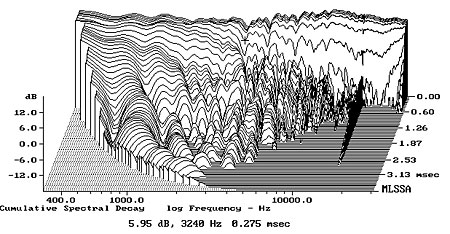
This issue of breakup is worth elaboration. Ideally, a dynamic loudspeaker diaphragm should act as a piston, with all points in uniform motion. However, since diaphragms are not infinitely rigid, there will be a condition at which the forces acting upon it cause oscillating deflections resulting in different points on the surface moving in different directions. Under this condition, the diaphragm is said to be in breakup, and there is an attendant increase in distortion. Both aluminum and titanium compression driver diaphragms are in breakup for much of their response. On a large format driver, the breakup modes for aluminum diaphragms occur as low as 7000hz, and for titanium diaphragms, as low as 4000hz.
In 1999, Doug Button began development on a new series of compression drivers that would result in the 435Be. With the 435Be, Doug wanted to address both the bandwidth and output requirements without compromise in distortion. The goal was to have a driver that was pistonic throughout its bandwidth and have extension that did not rely on parasitic resonance. The solution was in a different diaphragm material – beryllium. The use of beryllium in compression drivers was not new. The TAD division of Pioneer had been producing such drivers for many years. However, the approach and design objectives set for the 435Be were unique.
435Be Beryllium Diaphragms
© Don McRitchie
To ensure pistonic response, Doug specified a smaller 3" diameter. A beryllium diaphragm of this size ensured that breakup modes would be above 15.5khz. A thin layer of Aquaplas was applied to the back of the diaphragm to damp spurious resonances. The diaphragm was also light enough for extension to that frequency without parasitic resonance. Total moving mass was only 1 gram, with the diaphragm less than 0.5 grams. This was less than a third the weight of previous materials.
While the switch to beryllium addressed distortion and extension issues, it would not address the requirement for high output since a surround formed out of this same material has much less fatigue resistance than the titanium it replaced. Doug addressed this in a very innovative way, with a unique composite design. He specified a kapton surround that would be immune to fatigue failure. However, previous composite designs always proved problematic due to the need to have the diaphragm, voice coil former and surround all attach at the same point. Doug solved this issue by having the kapton surround formed into a deep well just before the point where it attaches to the diaphragm. The voice coil was dropped into this well, which eliminated the need for a former, and thus, only the surround had to be fastened to the diaphragm. This resulted in a very robust design with reduced moving mass.
Doug next worked to minimize the weight of the overall driver. The use neodymium allowed for a very small magnet. The unique external magnet topology resulted in an extremely efficient magnetic circuit with an absolute minimum of material. It resulted in a gap flux density of 2 Tesla in a driver that weighed less than 3lbs. In comparison, JBL's large format compression drivers weigh as much as 30lbs to achieve the same gap flux density.
435Be Cross-Section
© Harman International
Another unique feature of this driver is that it does not have a traditional throat. The phase plug terminates at the driver exit. It results in an effective flare rate of 550hz. Previously, virtually every compression driver made had a 180hz flare rate whose origin dates back to the original AT&T Labs designs from the 1930's. This low rate was necessary to accommodate the low cross-over points used in early two-way loudspeakers. However, this low rate compromised high frequency performance. Given that there was no need for such low frequency output for the 435Be, the flare rate could be optimized to result in a 6db drop in second harmonic distortion.
The final result was the highest performing high frequency driver ever produced by JBL. The stiff, light beryllium diaphragm has such excellent transient response that its sonic character is more near an electrostatic design than previous compression drivers. Distortion was reduced to levels never previously attained at JBL. All of this was accomplished with a driver whose output, and thus dynamic range, were fully in keeping with the hallmarks of the JBL brand.
© 2004 Don McRitchie
based on information provided
by Doug Button |
|
 楼主: 今夜星光


 京公网安备 11010602010207号
( 京ICP证041102号,京ICP备09075138号-9 )
京公网安备 11010602010207号
( 京ICP证041102号,京ICP备09075138号-9 )













 狗仔卡
狗仔卡
 发表于 2009-12-30 15:01


 楼主
楼主