UID150003
威望5
金钱15419
交易诚信度15
主题3
帖子43
注册时间2005-6-2
最后登录2025-1-6
中级会员

交易诚信度15
注册时间2005-6-2
|
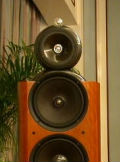
我之前的系统是Exposure2010S CD机, SIM AUDIO I-3,丹拿 Contour 1.1, 现在新入手KEF XQ40,用雅俊CD192,A32一套西装推,感觉不错,始终是三分频的落地箱,终于能坐下来好好听交响乐和室内乐(之前Contour 1.1没有气势),正在调整线材,希望有更好的表现。
现在很多人对KEF不屑一顾,认为在国内生产后就没有好货了,反而是国外用家的评价更高,希望大家还是耳朵收货吧。下面的洋文大家自己看吧:
KEF’s XQ line consists of two bookshelf models, two towers, a center-channel,
and a subwoofer, the three-way XQ40 tower ($4500 USD per pair) being the top
dog. Once I’d unpacked them, I removed the sturdy grilles, which cleverly attach
with magnets flush-mounted in their frames. The magnets adhere to the speaker’s
faceplate of brushed metal, while the entire grille is precisely positioned via
rubber dimples that fit into the shallow sockets of the countersunk faceplate
screws.
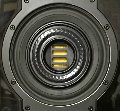
Immediately, my eye was drawn to the titanium-finished Uni-Q driver array. At
the center of the midrange cone, where you’d normally find a dustcap or phase
plug, is a 0.75” elliptical aluminum-dome tweeter capable, KEF claims, of
singing all the way up to 55kHz. Protecting the tweeter is something that KEF
calls its “tangerine” waveguide. This is said to not only protect the tweeter,
but also to aid in providing a smoother, more even dispersion of high-frequency
energy, to yield a more natural sound.
Another key factor of the Uni-Q technology is driver placement. Using aerospace
technology originally designed by NASA, the tweeter is mounted at the precise
acoustic center of the midrange cone, which essentially time-aligns the two
drivers. The advantage of this is twofold: First, a narrow listening “sweet
spot” is all but eliminated, as the dispersion of sound is performed far more
evenly across the room than is typically possible with more traditional
multi-driver designs, thus vastly improving soundstaging and depth of field.
Second, the speaker positions become less critical. The performance advantages
offered by this technology are applicable to both two- and multichannel systems.
Taking over from the tweeter at 2.5kHz is the other half of this coaxial Uni-Q
driver: a 6.5” midrange cone made of a layer of polypropylene between two
titanium skins. This is responsible for handling frequencies down to 400Hz, at
which point two independently loaded, 6.5”, “ultra-low-distortion” bass drivers
handle the low end, from 400 to 45Hz, ±3dB. To achieve this excellent response
from such small drivers, KEF increased the excursion of the bass drivers’
pistons by redesigning their coils to be of low mass and to use edge-wound
aluminum wire coated in copper. In addition, these bass drivers’ dynamic range
was increased by way of Faraday rings, which coincidentally help reduce overall
harmonic distortion. Managing all of these frequencies are fourth-order
crossovers derived from KEF’s Reference Series and said to use audiophile-grade
components. The crossover boards are decoupled from the cabinets in an effort to
isolate them from unwanted vibrations and internal acoustic pressures.
Encompassing all of this technology is one of the most elegant, luxuriously
finished cabinets I have seen on a speaker costing up to twice the XQ40’s price
(save Monitor Audio’s Platinum series). Standing 40”H, just under 1’D, just over
9”W, and weighing 53.5 pounds, the XQ40 leans back slightly -- the look is
distinctively high-end. The XQ40 is available in high-gloss Khaya Mahogany,
Birdseye Maple, or Piano Black. Under the classy veneer is an extensively braced
cabinet built entirely of 0.5”-thick MDF, with separate enclosures for each bass
driver and another for the Uni-Q assembly. The side, top, and bottom panels are
bowed and taper toward the back, in an effort to eliminate internal standing
waves.
The XQ40 is a bass-reflex design in which each bass driver has a dedicated,
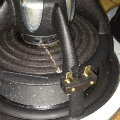
forward-firing port. At the base of the rear panel are four high-quality binding
posts to permit biwiring or biamping, spaced far enough apart to easily
accommodate large cables, regardless of termination. My only quibble is that the
XQ40’s support spikes and feet offer little in the way of lateral stability.
Power, timing, finesse
While reviewing the XQ40, I was surprised to find that despite its three-way,
four-driver architecture, nominal impedance of 8 ohms, and efficiency of 90dB,
the speaker was surprisingly easy to drive. When I dug a bit deeper into the
supplied specs, however, I learned that the XQ40 can drop into the low 3-ohms
region when pushed hard with bass-heavy material. This is nothing to be
concerned about; for most intents and purposes, the XQ40 can be driven by any
decent-quality receiver. However, I’d wager that anyone willing to buy speakers
of this caliber will be driving them with amplifiers of equal or greater
caliber. As luck would have it, I happened to have three such amplifiers on
hand.
I broke in the KEFs with my tried-and-true 200Wpc reference amp, Rotel’s
RMB-1095. I’m very familiar with the Rotel’s sound, and knew it would have no
problem driving the KEFs to their full potential. During the break-in period,
most of the changes I heard in the XQ40s’ sound occurred quite quickly -- the
speakers took less than 50 hours to fully settle in.
I began my serious listening with some lighter fare: The Very Best of Diana
Krall (CD, Verve 0251741595). The double-bass solo at the beginning of “All or
Nothing at All” was the first surprise the KEFs had in store for me, rendering
it with incredible focus and depth and placing the instrument dead center and
low on the stage. Each note was clearly articulated from start to finish,
allowing me to follow the bassist’s fingers as he plucked each string, and
appreciate the natural decay of each note. When Krall began to sing, her voice,
too, was dead center -- but slightly higher, as if she were sitting on a stool.
The Uni-Q drivers really strutted their stuff here, offering excellent timing
and tightly focused images. This made it easy for me to paint in my head a
picture of where everyone and everything was on the soundstage. What’s more, the
XQ40s did this while I was sitting about 15 degrees off axis.
Wanting to hear what the KEFs could do with something a bit more lively, I cued
up “Come As You Are,” from Nirvana’s self-titled album (CD, Geffen 06949350720).
The kick drum at the beginning of this track was delivered with real punch, and
the visceral nature of Kurt Cobain’s voice was immediately apparent.
Unfortunately also apparent was a slight emphasis in the mid- to upper midrange.
Some call this part of the audioband the presence region, and with almost all
the music I listened to through the KEFs, I found this region slightly more
pronounced than I’m used to. At times this was welcome, as it made subtle
details more obvious and could add a bit of life and vibrancy to an otherwise
dull recording. But with already vibrant recordings, or compressed music played
at higher levels, it could induce a bit of listening fatigue over time. Having
noticed this with several different recordings, I decided it might be a good
time to try a different amplifier and see if this characteristic persisted.
In addition to the Rotel, whose sound is fairly neutral, I had on hand two
distinctly different amplifiers just itching to put the KEFs through their
paces. Rated at 150W for each of its nine channels, Integra’s DTA-70.1
home-theater amp has a unique architecture that lets it crank out over 180Wpc
into a two-channel rig. The other power pusher on hand was Bel Canto’s REF150,
rated at 75Wpc and based on Bang & Olufsen’s ICEpower technology (review coming
soon). These three amps use very different design approaches, and each has its
own sonic signature. Although the KEF XQ40s were easily powered by any of them,
it was the surprisingly warm and natural sound offered by the . . . well, I
won’t spoil the surprise.
With the Rotel RMB-1095 the sound was consistently clean, articulate,
full-bodied, and controlled. With all that power on tap, the KEFs could dig
convincingly deep when told to, delivering swift dynamic swings and offering
meticulously imaged instruments and voices in their respective places. By
contrast, the somewhat analytical nature of the Integra DTA-70.1 tended to
emphasize that upper-midrange bump, favoring detail over musicality. Such
audible differences effected by simply changing amplifiers showed that the XQ40
is a very revealing speaker, and that care should be taken when selecting
associated equipment.
But within minutes of inserting the Bel Canto REF150 in my system, it was clear
that this would be the last amplifier swap I would be performing for this
review. The Bel Canto’s smooth, faintly warm sound proved to be the best
companion for the KEFs. The soundstaging scale was on a par with the Rotel’s,
but images on that soundstage now had tighter focus, voices had less grain, and
the timing was superior -- all of which contributed to a more relaxed and
believable sound. Piano notes, in particular, lingered in the air with dimension
and left with wonderful decay. The midrange bump that had reared its head from
time to time with the Rotel, and especially with the Integra, was now a thing of
the past.
I cued up “Wicked Game,” from Chris Isaak’s Best of compilation (CD, Warner
Music Canada CDW 49418). Rowland Salley’s bass line had just enough impact and
weight to be convincing through the Bel Canto, but simply thumped when driven by
the Rotel. The KEFs did a credible job of portraying the dynamic range of
Isaak’s singing, too; I couldn’t help but appreciate the emotional intent of his
performance, as supplemented by the seductive bass line. The XQ40s presented the
lead electric guitar of James Calvin Wilsey in a rich, melodic manner,
complemented by Kenney Dale Johnson’s subtle taps of his cymbals and his brushed
snare.
“Brothers in Arms,” from Mark Knopfler’s Private Investigations (CD, Mercury
0249874051), sounded massive through the XQ40s. The rolling thunder at the
beginning of this track extended well beyond the speakers in a soundstage as
wide as it was deep -- and this was with the speakers not more than a foot from
the front wall. Later on in this track, Knopfler’s electric guitar was portrayed
with an earthy texture, his voice had a particularly raw yet natural character,
and the percussion instruments were reproduced with subtle dynamic shades all
across the soundstage.
Comparison
I’ve listened to countless speakers over the years, and it wasn’t too long ago
that I was very happily using a pair of B&W 804S speakers ($4000/pr. when
available) as my references. During my time with them, I valued their lovely
top-end detail and palpable if somewhat colored midrange. Their build quality
was simply outstanding, and, driven by properly matched ancillaries, their
musicality proved tough to beat. What I grew increasingly disappointed with,
however, was the B&Ws’ bass performance, the time required to position them
properly, and how much space they demanded -- in all directions around them, and
between them and me -- to sound their best.
The KEF XQ40 was expert in all of these areas. It’s one of the easiest speakers
to set up I’ve had the pleasure of working with, due to that lack of a locked-in
sweet spot; its bass performance was impressive for a tower of such modest size;
and its midrange was decidedly neutral. Using so neutral a speaker can be risky
-- it will showcase any weak links in a system and recordings -- but I take it
as an opportunity to improve my system, not to keep me from listening. Overall,
the XQ40’s build quality is on a par with the B&W’s, but the KEF’s cabinet --
with its curved top and bottom plates, raked stance, and high-gloss finish --
is, to me, a classier, more stylish statement. The one thing for which I still
prefer the B&W 804S is its articulate top end. The KEF was wonderfully detailed
and superbly timed, but it just couldn’t match the B&W’s rendering of texture.
Summing up
In my years as a reviewer and audio enthusiast, I have auditioned several
speakers that have impressed me in one way or another: some with their
appearance, others with their sound, and some for how they went about the
business of reproducing sound. But a speaker that does more than one of these
things, let alone all three, is a rarity, especially for only $4500/pair.
The KEF XQ40 is one of those rarities. From top to bottom, KEF’s XQ flagship is
an exceedingly well built, classically styled tower that sounds as good as it
looks. It may not be the last word in neutrality across the entire audioband,
and it might require some close attention in being paired with other audio gear,
but the best things in life are never easy, and I have yet to hear a speaker in
this price range that can match its low-end prowess. Equally impressive was the
ability of a pair of XQ40s to present a rock-solid image without my having to
first endlessly fuss with positioning them, and then make sure I never moved
from a narrow sweet spot.
If you’re in the market for a speaker that performs well above its price and
looks as if it costs twice that, I highly recommend an audition of the KEF XQ40.
I immensely enjoyed my time with them -- so much that I’ve decided to retire my
B&W 804Ses and buy the XQ40s. They’ll be my new reference speakers.
[ 本帖最后由 gygz 于 2011-3-23 21:06 编辑 ] |
|
 楼主: 赵晖


 京公网安备 11010602010207号
( 京ICP证041102号,京ICP备09075138号-9 )
京公网安备 11010602010207号
( 京ICP证041102号,京ICP备09075138号-9 )













 狗仔卡
狗仔卡
 发表于 2010-2-12 19:59