UID405168
威望246
金钱1227124
交易诚信度0
主题974
帖子17961
注册时间2007-4-9
最后登录2025-2-19
核心会员

交易诚信度0
注册时间2007-4-9
|
本帖最后由 叶荣玉 于 2012-12-19 15:47 编辑
完全可以的,,,,anthem 225是去年欧州获what HI-FI大奖的新产品。。。。人气不错。。。

While the new Integrated 225 is the only integrated amplifier in Anthem’s current line, it’s not their first. In the mid-’90s they created the Integrated 1, a tubed model that produced 25Wpc into 4 or 8 ohms. It was superseded by the Integrated 2, a hybrid design that used tubes in its preamplifier and transistors in its power amp, and output 90Wpc into 8 ohms or 145Wpc into 4 ohms. The Integrated 225 is said to deliver 225Wpc into 8 ohms or 310Wpc into 4 ohms. It’s Anthem’s most powerful integrated yet, and the most powerful I’ve ever reviewed, but it’s certainly not the most expensive at just $1499 USD -- not much for such a powerful device.
Description
Not only is the 225 heavy, but its build quality is outstanding. This is no flimsy, throwaway integrated. In fact, the build quality is more suited to something costing twice as much. In fact, when the Integrated 225 first arrived, I was surprised by its weight. For the price, I hadn’t expected something so hefty and well built -- it measures 17 1/4"W x 5 7/8"H x 18"D and tips the scales at 43 pounds. This makes it not only the most powerful integrated I’ve reviewed, but one of the most substantial as well.
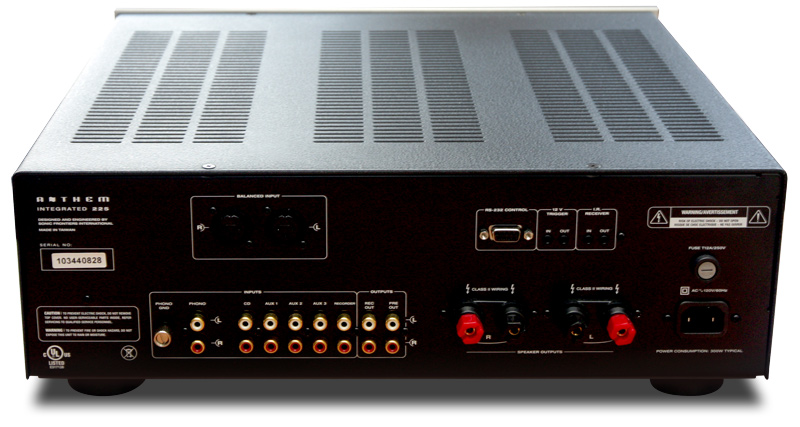
The Integrated 225’s rear panel is well populated: five RCA inputs, one set of balanced inputs (which I didn’t use; I own no balanced source components), one line-level output, a preamplifier output (for connecting an external power amp), and, best of all, an input for the onboard moving-magnet phono stage. With sales of vinyl and turntables on the rise, it’s nice to see a product that comes ready to play LPs right out of the box. Not only does the built-in phono stage save the cost of buying an external one (which you can still do if you prefer), it has the added benefit of making the signal path between phono stage and preamp as short as possible.
Also on the rear are an RS-232 port, 12V trigger inputs and outputs, and an IEC receptacle for the detachable power cord. The single pair of binding posts can accommodate banana plugs, spades, or bare wires. And the Integrated 225 is wide and high enough to provide plenty of space around all the connectors.
On the brushed-aluminum front panel are the volume knob, a balance control, bass and treble controls (along with a Tone Defeat switch to remove them from the signal path), input selection buttons, a power switch, a headphone jack, and, finally, a stereo mini-jack for connecting an iPod or other portable audio device. Because many people now carry their entire music collections around on hard drives small enough to slip into a shirt pocket, it’s nice that Anthem has made connecting them as convenient as possible.
With its silver faceplate and black case, the Integrated 225 doesn’t exactly deviate from the design trends current among integrated amps; however, it’s attractive enough to blend in with almost any d閏or.
The remote control has one unexpected feature: a nice backlit display that comes on when any button is pressed. This learning remote can be taught commands and used to control other components in your system.
My only problem with the Integrated 225 was a functional one: Controlling the volume via the remote was difficult because the remote is too sensitive. Only a slight tap on the Volume button increased or decreased the level more than it should have, making it difficult to find a suitable volume without constantly over- and undershooting. My only suggestion for Anthem: Slow the volume control down a bit.
System and sound
The Integrated 225 drove PSB’s Platinum M2 stand-mounted speakers, whose nominal impedance PSB claims to be 4 ohms. I used AudioQuest Type 4 speaker cable terminated with banana plugs. Kimber Kable Tonik interconnects linked up the NAD C542 CD player that served as my digital front end. Performing analog duties were a Thorens TD-160HD turntable fitted with a modified Rega RB250 tonearm, on which was mounted Dynavector’s DV-10X5 high-output moving-coil cartridge (see sidebar).
When I turned the Integrated 225’s Bass and Treble dials to 12 o’clock and shut the Tone Defeat switch off, I could detect no difference in the sound. Still, I decided to keep the tone controls out of the circuit, and left Tone Defeat engaged throughout my listening sessions.
As I sift through my notes, trying to figure out what I want to say about the sound of the Integrated 225, four things keep popping up: neutrality, midrange clarity, expansive soundstaging, and seemingly limitless power. The more I listened to the 225, the more I noted these qualities.
In terms of neutrality, the Integrated 225 was the proverbial chameleon in its ability to take on the character of whatever disc I played without infusing the music with any sound of its own. It wasn’t bright or dark, lean or warm, forward or recessed. As I listened to discern any sort of flavor to its sound, nothing jumped out at me. For those unaccustomed to it, a component that appears to have no sonic signature at all might seem to sound a bit drab. After all, some electronics with serious colorations (tube models come to mind) can tend to seem exciting at first, not unlike punching up the colors on a TV. But that oversaturation can wear thin after a while; in my opinion, the components that impart the least character are the ones that are most enjoyable over the long term.
Unfortunately, this meant that some poorly recorded music sounded downright awful through the Anthem. For example, when I listened to some poor-quality MP3s played directly from iTunes by a MacBook computer, the Integrated 225 laid bare the muted dynamics, the two-dimensional soundstage, the complete absence of energy and vitality. This was a case of faithfully reproducing an audio signal, warts and all -- the 225 refused to pretty it up.
Of course, the flip side to this was that well-recorded material sounded simply sublime through the Anthem. This was particularly true of its reproduction of the midrange, that band of frequencies into which fall most musical instruments and the human voice. When I listened to Eddie Vedder hum along with his acoustic guitar in the instrumental version of his "Guaranteed," from the soundtrack for Into the Wild (CD, J Records 88697-15944-2), his distinctive baritone was as clear and detailed as the notes he strummed. I couldn’t help but think that, with the exception of sitting in the studio with the man as this track was being recorded, his voice probably couldn’t sound much better. The Integrated 225’s lack of editorializing meant that it could do an amazing job of bringing the song’s intimacy right into the room with me. What I heard sounded startlingly real.
Moving on to John Coltrane’s A Love Supreme, I marveled at Elvin Jones’ drum work during "Part 2 -- Resolution" (CD, Impulse! B000061002). As the clear shimmer of the cymbals and the flow of Coltrane’s tenor saxophone enhanced this track’s sense of true swing, it became clear that limitless power and midrange clarity weren’t the 225’s only strengths. It was also extremely refined sounding, particularly at the top end, where the sound of the cymbal lives. I ended up putting my pen down and listening to the rest of the disc.
Another of the 225’s strengths was its ability to cast a credible soundstage in my listening room, an indication of high resolution and low noise. When I put on the Great Lake Swimmers’ beautiful Ongiara (CD, Nettwerk 30691 2), I was amazed at how well the Anthem captured the acoustic space of Aeolian Hall in London, Ontario, where this album was recorded. This was especially apparent during Tony Dekker’s solo performance of "Passenger Song," in which the echo of his voice made the hall’s vastness easily perceptible. His guitar notes seemed to hang suspended in space, their isolation a fitting metaphor for the sentiment conveyed by the song. The 225 wasn’t merely neutral; it was also highly resolving, and did a fantastic job of getting out of the way and letting the music speak for itself.
As impressed as I’d been at first with the Integrated 225’s size, weight, build, and features, I was taken back by its power. Even driving 4-ohm speakers such as the Platinum M2s, the Anthem didn’t even begin to break a sweat. And despite putting it through some marathon listening sessions of five or six hours each, the 225 never even got that warm. It was clear that the 225 always had plenty of power in reserve, and that I never came close to pushing it to its limits. This integrated amp should be suitable for use with most loudspeakers out there.
| The Built-in Phono Stage -- a Great Place to Start Anthem’s Integrated 225 includes an onboard moving-magnet phono stage that’s also suitable for high-output moving-coil cartridges. Mounted on my Rega tonearm is a Dynavector DV-10X5, a moving-coil design with a voltage output of 2.5mV. It worked well with the Anthem’s phono stage. Music sounded clean and detailed while preserving the inherent warmth and ease of analog.Listening to Calexico’s Carried to Dust (LP, Quarterstick qs108), the clear, open sound conveyed excellent depth, and a wonderful sense of space that helped me appreciate the various atmospheres created by different tracks on this record. I had no trouble hearing into the massed assortments of strings, horns, and percussion. Ultimately I stopped writing notes, picked up the lyrics sheet, and lost myself somewhere on side A. The ability to lose the listener in the music isn’t something all components can do, but this was never a problem for the Anthem.With Bj鰎k’s Homogenic on the platter (LP, Bj鰎k Overseas Ltd. 539 166-1), I was again struck by the high level of performance achieved by the 225’s phono stage. Homogenic is a dense album with layers of instrumentation and complex musical arrangements that require multiple hearings to fully appreciate, and the 225 and its phono stage were the perfect tools for unraveling it all. This LP sounded enormous through the 225, creating sound that was wall-to-wall, floor-to-ceiling, and beyond. Bass was deep and tangible, and Bj鰎k’s voice soared through my system with a purity and ease that begged me to turn the volume up. I did so with enthusiasm.Much as I’d found the Integrated 225 itself, its phono stage was revealing of the quality of the recording without adding much of itself to the sound. You can certainly buy a better, more expensive phono stage that will outperform this one. However, the stage included in the Integrated 225’s price of $1499 was surprisingly accomplished, and will give someone who owns a turntable a great place to start without having to spend more, at least right away. My suggestion: If you have a turntable, try what’s here, live with it for a while, and upgrade later -- but only if you feel a real need to. In the meantime, you might find yourself perfectly content, and use the money you save to buy more LPs.. . . Philip Beaudette |
|
|
Large dynamic shifts in some of the classical music to which I listened didn’t faze the Integrated 225 even slightly. In practical terms, this meant there was lots of juice for convincingly reproducing the wonderful drone of the pipe organ in the final movement of Saint-Sa雗s’ Symphony No.3, with Charles Munch conducting the Boston Symphony (CD, BMG Classics 61387-2). The sheer power of the organ flooded my listening room, the Anthem doing a superb job of portraying the authority and weight of its low frequencies. It would have been fun to play this track through a pair of large, full-range speakers so the 225 could fully realize its potential by reproducing the lowest octaves, but even through the PSBs, the scale of the organ, the size of the orchestra -- even the sound of the hall in which the performance was recorded -- were all well preserved, creating a large-scale aural illusion in my listening room.
In the end, though, what most won me over was how faithfully the Integrated 225 reproduced my favorite music. The Great Lake Swimmers’ Ongiara is a wonderfully recorded album, but it took an integrated amplifier as superb as the Integrated 225 to reveal that fact. In "Backstage with the Modern Dancers," Tony Dekker’s voice appeared from behind the plane of the speakers, the drum kit several feet behind him. Not only was depth of the stage outstanding, so was its breadth, as Erik Arnesen’s banjo emerged with excellent clarity from behind the left speaker. Some integrated amplifiers tend to produce convincing depth at the center, but truncate the back corners of the stage. Not the Integrated 225. It managed the impressive feat of portraying a stage that had as much breadth along its back wall as it did at the plane of the speakers.
Overall, the Integrated 225 performed at such a high level that it left me with no nits to pick or anything to complain about. What Anthem has achieved for $1499 is nothing short of remarkable.
Comparison
I pitted the Integrated 225 against another high-value integrated amplifier, NAD’s C372 ($999). The C372 is another powerhouse, rated at 150Wpc into 4 or 8 ohms. On paper, the Anthem’s 225Wpc wins. But at the volumes at which I listen to music, both integrateds had more than enough watts, with plenty in reserve. If you have a big room and/or inefficient speakers, total power output will be more important and the Anthem will be the better choice. For me, either amp was sufficient.
In terms of connectivity the two are similar, with some differences. The NAD has seven single-ended inputs compared to the Anthem’s five, but the C372 lacks the 225’s balanced inputs and onboard phono stage -- not insignificant, if you have equipment to hook up to those.
Feature-wise, the Anthem’s only edge is its remote: backlighting is a handy thing that, now that I’m used to it, I wouldn’t want to do without. Cosmetically, the Integrated 225’s sleek appearance might impress a few more people than the C372’s battleship gray. On the other hand, I’ve always admired the utilitarian look of NAD gear, so this is really a matter of taste.
The build qualities aren’t in the same league. The Integrated 225 is more than 15 pounds heavier, and looks and feels like it. With its thicker, sturdier chassis and faceplate, it’s a far more substantial component that makes the C372 feel flimsy in comparison.
Because I never taxed the total power output of either integrated, I was surprised to discover that they sounded quite different. Listening to Neil Young’s "Out on the Weekend," from Harvest (CD, Reprise 2277), through the NAD C372, the drums had punch and clarity but weren’t as sharply defined or as aggressive in attack as through the Anthem Integrated 225 -- the NAD sounded fatter and more rounded, whereas the Anthem had more bite and seemingly better control. Young’s voice sounded more forward through the C372, and more isolated from the musicians around him. With the Integrated 225, Young’s voice seemed a more coherent part of the musical whole, not standing out as much as they had with the NAD. I attribute this to the 225’s extracting more detail and simply conveying more of the information that’s on this disc. Finally, Young’s harmonica sounded a touch brighter in its upper registers through the C372; through the Anthem it sounded crystal clear, but I actually wanted to turn the volume up. Overall, I found that the 225 sounded more refined, particularly up top.
The NAD C372 has a warm, friendly sound, but it’s not as refined or as precise as the Anthem. The Integrated 225 could come off as sounding a tad lean and dry, comparatively, but I found it more resolving, natural, and neutral. The Anthem costs 50% more, but in the final analysis was a clear step up from the C372, particularly when you factor in the features (including the excellent phono stage; see sidebar), build quality, and power output. To me, that’s all worth it.
Conclusion
At its price, the only fault I could find with Anthem’s Integrated 225 was a functional one: the volume-control problem. Otherwise, the Integrated 225 is a real gem with a wealth of features, more power than most people will ever need, and sound quality that belies its asking price of $1499. You’d likely have to spend twice as much to get something better . . . but why should you? The Integrated 225 is so good, you may never have to or want to.
. . . Philip Beaudette
|
|
 人老是自然规律。等那些老的烧友仙去,你也会变老了的。当你老了的时候你会知道,在对声音的整体领会中,並不是能听到更高频率,就等于会听音乐。总不会认为儿童比你更会理解音乐吧?而且这样不着边际的比较,什么也说明不了吗,这就像说调查过某二个收入相差几十倍的人,证明收入

 京公网安备 11010602010207号
( 京ICP证041102号,京ICP备09075138号-9 )
京公网安备 11010602010207号
( 京ICP证041102号,京ICP备09075138号-9 )














 狗仔卡
狗仔卡
 发表于 2012-12-18 11:43



 变色卡
变色卡 楼主
楼主




 耐心点,,,
