UID355664
威望6
金钱104543
交易诚信度0
主题35
帖子2135
注册时间2006-12-24
最后登录2026-3-28
中级会员

交易诚信度0
注册时间2006-12-24
|
马上注册 家电论坛,众多有奖活动等你来参与!
您需要 登录 才可以下载或查看,没有账号?注册

x
Dynaudio Evidence Temptation loudspeaker

Sidebar 3: Measurements
All measurements were taken using DRA Labs' excellent MLSSA system. However, the bulk and weight of the Dynaudio Evidence Temptation made it impossible for me to raise it off the floor for the acoustic measurements. As a result, the anechoic time window was not as long as I usually enjoy, due to the presence of an early reflection from the ground, which will reduce the resolution of the measurement in the midrange. However, the amplitude of this reflection was not as great as I was expecting, due, I imagine, to the speaker's controlled vertical dispersion, with the radiating length decreasing with increasing frequency. The Temptation goes very loud with only a small input signal—I estimated its voltage sensitivity as a high 91dB(B)/2.83V/m. However, its impedance (fig.1) is moderately difficult, with a minimum value of 3.1 ohms at 120Hz and a demanding combination of 4 ohms and a 42 degrees capacitive phase angle at 80Hz.  Fig.1 Dynaudio Temptation, electrical impedance (solid) and phase (dashed). (2 ohms/vertical div.) The saddle at 28Hz in this graph's magnitude trace indicates the tuning frequency of the twin large-diameter ports. Note, however, that the traces are free from the small wrinkles and discontinuities that would otherwise indicate the presence of cabinet resonances. Fig.2, a waterfall plot derived from the output of a piezoelectric accelerometer fastened to the side of the midrange enclosure, confirms that the Temptation's cabinet is acoustically inert. I detected no other modes of any significance. Fig.1 Dynaudio Temptation, electrical impedance (solid) and phase (dashed). (2 ohms/vertical div.) The saddle at 28Hz in this graph's magnitude trace indicates the tuning frequency of the twin large-diameter ports. Note, however, that the traces are free from the small wrinkles and discontinuities that would otherwise indicate the presence of cabinet resonances. Fig.2, a waterfall plot derived from the output of a piezoelectric accelerometer fastened to the side of the midrange enclosure, confirms that the Temptation's cabinet is acoustically inert. I detected no other modes of any significance. 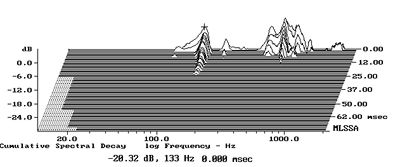 Fig.2 Dynaudio Temptation, cumulative spectral-decay plot of output of accelerometer fastened to midrange enclosure side panel. (MLS driving voltage to speaker, 7.55V; measurement bandwidth, 2kHz.) Fig.3 shows the individual outputs of the midrange units, woofers, and ports, all measured in the nearfield; ie, with the microphone capsule (a Mitey Mike II) almost touching the diaphragms or the boundary between the port and the outside world. The port output is the broad bandpass centered on the 20-40Hz octave; while there is some output visible both around 160Hz and in the middle of the midrange, this is well suppressed. The sum of the woofer responses has its minimum-motion point at the port tuning frequency of 28Hz, as expected from the impedance plot, and it appears to roll off smoothly above 200Hz, with a first-order slope. The sum of the midrange units' response also appears to roll off below 200Hz with, again, a first-order, 6dB/octave slope. There are some small peaks and dips evident in what would otherwise be a smooth curve; as it is not possible to drive the woofers and midrange units separately, it's possible that these effects are due to interference from the output of the woofers. Fig.2 Dynaudio Temptation, cumulative spectral-decay plot of output of accelerometer fastened to midrange enclosure side panel. (MLS driving voltage to speaker, 7.55V; measurement bandwidth, 2kHz.) Fig.3 shows the individual outputs of the midrange units, woofers, and ports, all measured in the nearfield; ie, with the microphone capsule (a Mitey Mike II) almost touching the diaphragms or the boundary between the port and the outside world. The port output is the broad bandpass centered on the 20-40Hz octave; while there is some output visible both around 160Hz and in the middle of the midrange, this is well suppressed. The sum of the woofer responses has its minimum-motion point at the port tuning frequency of 28Hz, as expected from the impedance plot, and it appears to roll off smoothly above 200Hz, with a first-order slope. The sum of the midrange units' response also appears to roll off below 200Hz with, again, a first-order, 6dB/octave slope. There are some small peaks and dips evident in what would otherwise be a smooth curve; as it is not possible to drive the woofers and midrange units separately, it's possible that these effects are due to interference from the output of the woofers. 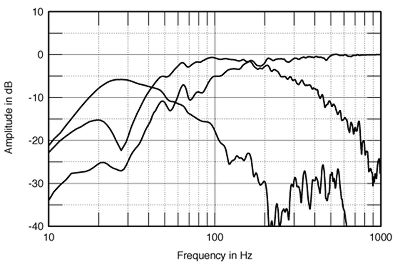 Fig.3 Dynaudio Temptation, summed nearfield responses of the midrange units, woofers, and ports. The complex sum of the individual responses is shown in the left portion of fig.4. The speaker's bass response is down by 6dB at the port tuning frequency, with a 24dB/octave rolloff below that point. Higher in frequency, the midrange and treble regions—assessed in the farfield with a calibrated B&K microphone and averaged across a 30 degrees horizontal window on an axis midway between the twin tweeters—are basically flat, though with a couple of small suckouts apparent in the low treble. Fig.3 Dynaudio Temptation, summed nearfield responses of the midrange units, woofers, and ports. The complex sum of the individual responses is shown in the left portion of fig.4. The speaker's bass response is down by 6dB at the port tuning frequency, with a 24dB/octave rolloff below that point. Higher in frequency, the midrange and treble regions—assessed in the farfield with a calibrated B&K microphone and averaged across a 30 degrees horizontal window on an axis midway between the twin tweeters—are basically flat, though with a couple of small suckouts apparent in the low treble.  Fig.4 Dynaudio Temptation, anechoic response on axis midway between the two tweeters at 50", averaged across 30 degrees horizontal window and corrected for microphone response, with the complex sum of the nearfield midrange, woofer, and port responses plotted below 300Hz. Fig.4 Dynaudio Temptation, anechoic response on axis midway between the two tweeters at 50", averaged across 30 degrees horizontal window and corrected for microphone response, with the complex sum of the nearfield midrange, woofer, and port responses plotted below 300Hz.
There is a slight positive plateau evident between 9kHz and 15kHz, which might be thought to add a slight brightness to the perceived balance. However, the Temptation's lateral dispersion plot (fig.5) shows that the speaker is quite directional in this region. In a typical room, the resulting lack of energy in the top two octaves of the reverberant field will work against the on-axis boost, giving a neutral character to the speaker's treble, though the 5-9kHz region might still stand out a bit in small, live rooms.
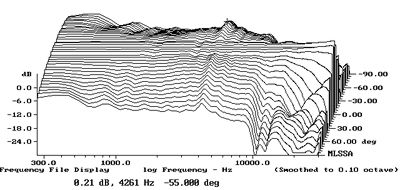 Fig.5 Dynaudio Temptation, lateral response family at 50", from back to front: responses 90 degrees-5 degrees off-axis, central tweeter-axis response, responses 5 degrees-90 degrees off-axis. Other than the increased directivity above 9kHz, the Temptation's lateral radiation pattern is wide and even, which will help ensure stable, accurately defined stereo imaging. In the vertical plane (fig.6), the speaker's multiple drive-units and first-order crossover filters give rise to quite complicated behavior. To get the optimal sound quality, you basically need to sit close to the middle of the tweeters with your ears a highish 39" from the floor—as LG discovered in his auditioning. Fig.5 Dynaudio Temptation, lateral response family at 50", from back to front: responses 90 degrees-5 degrees off-axis, central tweeter-axis response, responses 5 degrees-90 degrees off-axis. Other than the increased directivity above 9kHz, the Temptation's lateral radiation pattern is wide and even, which will help ensure stable, accurately defined stereo imaging. In the vertical plane (fig.6), the speaker's multiple drive-units and first-order crossover filters give rise to quite complicated behavior. To get the optimal sound quality, you basically need to sit close to the middle of the tweeters with your ears a highish 39" from the floor—as LG discovered in his auditioning. 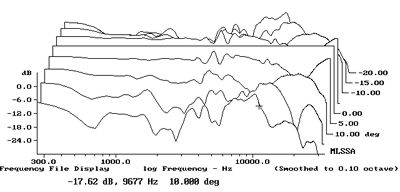 Fig.6 Dynaudio Temptation, vertical response family at 50", from back to front: differences in response 15 degrees-5 degrees above central tweeter axis, reference response, differences in response 5 degrees-15 degrees below central tweeter axis. In the time domain, the Dynaudio's step response (fig.7) indicates that the tweeters and woofers are connected with positive acoustic polarity, the midrange units with negative polarity. While the Temptation is not time-coherent, each pair of drive-units' step response smoothly hands over to the next lower in frequency, implying good amplitude-domain integration, as seen in fig.4. The farfield cumulative spectral-decay plot (fig.8) is basically clean, particularly in the treble, but is marred by some delayed energy at 4.3kHz, the frequency of the lower of the two on-axis suckouts. I suspect that this is the result of acoustic interference rather than a resonance as such. Fig.6 Dynaudio Temptation, vertical response family at 50", from back to front: differences in response 15 degrees-5 degrees above central tweeter axis, reference response, differences in response 5 degrees-15 degrees below central tweeter axis. In the time domain, the Dynaudio's step response (fig.7) indicates that the tweeters and woofers are connected with positive acoustic polarity, the midrange units with negative polarity. While the Temptation is not time-coherent, each pair of drive-units' step response smoothly hands over to the next lower in frequency, implying good amplitude-domain integration, as seen in fig.4. The farfield cumulative spectral-decay plot (fig.8) is basically clean, particularly in the treble, but is marred by some delayed energy at 4.3kHz, the frequency of the lower of the two on-axis suckouts. I suspect that this is the result of acoustic interference rather than a resonance as such.  Fig.7 Dynaudio Temptation, step response on axis midway between the two tweeters at 50" (5ms time window, 30kHz bandwidth). Fig.7 Dynaudio Temptation, step response on axis midway between the two tweeters at 50" (5ms time window, 30kHz bandwidth). 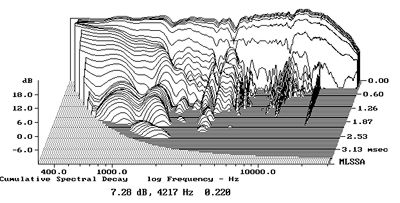 Fig.8 Dynaudio Temptation, cumulative spectral-decay plot at 50" (0.15ms risetime). Overall, this is excellent measured performance that indicates similarly excellent loudspeaker engineering.—John Atkinson Fig.8 Dynaudio Temptation, cumulative spectral-decay plot at 50" (0.15ms risetime). Overall, this is excellent measured performance that indicates similarly excellent loudspeaker engineering.—John Atkinson |
|


 京公网安备 11010602010207号
( 京ICP证041102号,京ICP备09075138号-9 )
京公网安备 11010602010207号
( 京ICP证041102号,京ICP备09075138号-9 )














 狗仔卡
狗仔卡
 发表于 2011-7-4 11:42
 变色卡
变色卡 楼主
楼主
 Fig.1 Dynaudio Evidence, electrical impedance (solid) and phase (dashed). (2 ohms/vertical div.) The saddle in the impedance curve at 28Hz defines the tuning of the large, 4"-diameter ports on the rear of the woofer subenclosures, which in turn implies excellent low-frequency extension. This can be seen in fig.2, which shows the individual outputs of one each of the ports and woofers, and the midrange/tweeter module (footnote 1). The port output is the bandpass centered on 28Hz, the same frequency as the notch in the woofer outputs. (At this frequency, the back pressure from the port resonance effectively holds the woofer cones still and all the acoustic output comes from the port.) There is some hashy-looking output from the port between 200Hz and 700Hz, but this is well down in level and will be further suppressed by the fact that the ports are on the rear of the two woofer enclosures. The four woofers handle the 45-200Hz range, with their output above the crossover frequency free from cone breakup problems.
 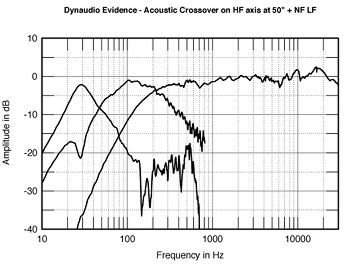 Fig.2 Dynaudio Evidence, acoustic crossover on tweeter axis at 50", corrected for microphone response, with the nearfield midrange, woofer, and port responses plotted below 600Hz, 900Hz, and 700Hz, respectively. Fig.3 shows the Evidence's farfield response, averaged across a 30 degree lateral window on an axis centered between the tweeters and spliced to the complex sum (magnitude and phase taken into account) of the nearfield responses of the woofers, ports, and midrange units. This response is astonishingly flat, with just a very slight lack of energy in the mid-treble and a slight shelving down in the port region. The latter is probably the right thing to do, given the usual amount of low-frequency "room gain" in all but the very largest rooms.
  Fig.3 Dynaudio Evidence, anechoic response on tweeter axis at 50", averaged across a 30 degrees horizontal window and corrected for microphone response, with the complex sum of the nearfield midrange, woofer, and port responses plotted below 300Hz.
  Fig.4 Dynaudio Evidence, lateral response family at 50", from back to front: responses 90 degrees-5 degrees off-axis, reference response on tweeter axis, responses 5 degrees-90 degrees off-axis.
  Fig.5 Dynaudio Evidence, lateral response family at 50", normalized to response on tweeter axis, from back to front: differences in response 90 degrees-5 degrees off-axis, reference response, differences in response 5 degrees-90 degrees off-axis. Fig.6 shows the manner in which the Dynaudio's response changes as the listener moves above or below the tweeter axis. The balance changes only slightly as the listener moves below the tweeter; for a standing listener, a suckout appears in the crossover region between the midrange units and tweeters.
  Fig.6 Dynaudio Evidence, vertical response family at 50", from back to front: differences in response 15 degrees-5 degrees above axis, reference response, differences in response 5 degrees-10 degrees below axis.
 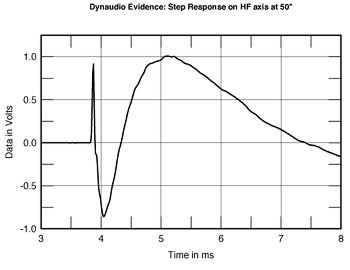 Fig.7 Dynaudio Evidence, on-axis step response at 50" (5ms time window, 30kHz bandwidth).
  Fig.8 Dynaudio Evidence, cumulative spectral-decay plot at 50" (0.15ms risetime). A question has been raised in recent issues of Stereophile: Why do so many expensive speakers seem to diverge in quality and measured performance rather than, as you might expect, converge? But Dynaudio's Evidence offers superb measured performance to accompany Larry Greenhill's praise for its sound. Yes, it is astonishingly expensive, but there is no doubt that it represents a serious attempt on the state of the loudspeaker art.—John Atkinson





 发表于 2011-7-4 12:22