家电论坛

广告合作
 注册  找回密码

QQ登录

只需一步,快速开始

手机号码,快捷登录

手机号码,快捷登录

查看: 6886|回复: 14

美国muse-2解码

[复制链接]

18

主题

669

帖子

0

威望

初级会员

Rank: 2Rank: 2

交易诚信度
2
注册时间
2010-8-28
发表于 2011-3-26 10:45 | 显示全部楼层 |阅读模式

马上注册 家电论坛,众多有奖活动等你来参与!

您需要 登录 才可以下载或查看,没有账号?注册

x
美国MUSE-2解码美国MUSE-2解码器,当年上美国发烧天书B榜。售价2500美金。采用双变压器,双PCM63K。美国本土使用,但电压120/240两种可直接使用。原厂设计通过开关设定使用电压。可直接使用220V电压。有原来包装。声音真实、秀气甜美、层次清晰、不温不燥。电路设计严谨,用料发烧,输出RCA镀铑的,平衡是镀金的。是听室内乐和民乐的选择。缺点是输出电平稍低,不够大气,国内不怎么了解此机。但性价比极高。实物拍照。。18907551378陈

[ 本帖最后由 chenxg 于 2011-3-31 12:46 编辑 ]
DSC04297.JPG
DSC04298.JPG
DSC04299.JPG
DSC04322.JPG
DSC04323.JPG
DSC04325.JPG
DSC04326.JPG
DSC04327.JPG
DSC04328.JPG
DSC04329.JPG
回复

使用道具 举报

25

主题

396

帖子

0

威望

初级会员

Rank: 2Rank: 2

交易诚信度
2
注册时间
2011-2-17
发表于 2011-3-26 10:46 | 显示全部楼层
zhen 真真正正的特富龙PCB线路板~~~~~~~~~~~~~~~~~~~~~~~~~~~~~~~~~
回复 支持 反对

使用道具 举报

25

主题

396

帖子

0

威望

初级会员

Rank: 2Rank: 2

交易诚信度
2
注册时间
2011-2-17
发表于 2011-3-26 10:50 | 显示全部楼层
April 1998 Muse Model Two Plus DACby Dave Duvall
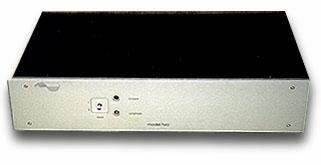
The Muse Model Two digital-to-analog converter was the first digital product to emerge from a company known for its amplifiers and world-class Model Eighteen subwoofer. Kevin Halverson, Muse’s chief engineer, and physicist Dr. Graham Hardy collaborated on the original Model Two, which received rave reviews in a number of the audiophile publications. Several years have gone by since the Model Two first made the audio scene, and today’s incarnation, the Model Two Plus, carries forth the name and legacy of the original gene pool.
Features
Standard on the Model Two Plus are unbalanced coaxial (BNC), balanced AES/EBU (XLR), and as far as I’m concerned, the best way to transmit digital data between transport and DAC currently available on the consumer market, the I2S output. S/PDIF has long been the most conventional method of digital transmission in consumer products, but as I reported several years ago in my review of the Audio Alchemy DDS PRO transport, DTI Pro 32 jitter attenuator, and v3.0 DAC, it is flawed in comparison to the performance of I2S. More opinions on that later. Also standard on the Model Two Plus is what Kevin claims to be "the most important improvement that I have offered," a fourth-order-passive impedance-equalized Bessel reconstruction filter. "The basic benefit over our standard reconstruction filter is that it has four times the stop-band attenuation along with flatter pass-band characteristics," Kevin explained.
As an option, and included on my review sample, the Pacific Microsonics PMD100 HDCD digital filter may be installed. If this filter is not requested, the Model Two Plus is supplied with a Burr-Brown 8x-oversampling digital filter. With the PMD100 filter installed, when an HDCD signal is detected, the emphasis LED on the front panel illuminates green, as opposed to red when the signal contains a pre-emphasized component. An I2S cable that utilizes the 13W3 connector, which resembles a computer parallel-port cable connector, may be ordered as an option. Kevin says, "If built properly--to my specification--any 13W3 cable would sound virtually the same as any other.. I have specifically engineered out any contribution that wire quality could have." He continued on to explain that "a properly designed interface should be completely independent of the implementation; the degree to which this is true speaks much about the design."
A Walk Around the Exterior
The Model Two Plus is a fine-looking product, with its 1/4"-thick, silver brushed-finish faceplate that’s a statement of simple elegance. The Model Two Plus is also available in black, for those who might find the silver not complimentary to other gear or environment. The case and faceplate together measure 17-1/2" wide, 11-3/8" deep, and 3-1/2" tall. The case is a two-piece machined steel enclosure. The top/side section is screwed down to the front/bottom/rear with 12 small machine screws, and the top has a sheet of damping material applied. Self-adhesive soft feet are supplied and can be placed on the bottom in whatever geometric arrangement the user prefers.
The front panel has a toggle switch recessed in a small rectangular section, this used to select either coax, AES/EBU, or I2S inputs. Directly beside this toggle switch are two LED indicators; the top one turns blue when the unit obtains locked status on a digital signal with a sampling rate between 32kHz and 48kHz, and the bottom is the emphasis/HDCD LED.
In addition to the digital inputs, the rear panel on the Two Plus includes pairs of single-ended (RCA) and balanced (XLR) output connectors. Standard output voltage is a low 1 volt, with 2-volt output offered as an option (at a possible sonic penalty from increased noise due to the extra gain). The 1-volt output works perfectly with my Audible Illusions preamplifier, the volume knob operating in the high-noon range for most listening. An IEC power-cable port and detachable power cable are included, allowing for the user to experiment with different after-market cords. While I found the factory-supplied power cord to be quite up to the task of music-making, I preferred the increased transparency I found using a Kimber PowerKord. Lastly, the rear panel provides for easy replacement of either a 1/2-amp (120 VAC/60Hz) or 1/4-amp (220/240 VAC 50/60Hz) fuse, to be done only after the power cord has been removed (because the DAC is on as long as it’s plugged in).
What’s Cooking Inside
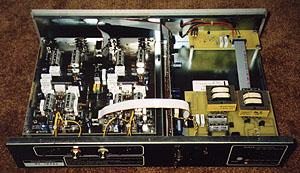
It is obvious that quality parts and engineering are to be found in the Model Two Plus DAC. One look inside tells the story. Quality from input to output, and the proper amount of territory allowed to do it in. The supplied manual describes the general functions of the Model Two Plus’s three main circuit boards quite well, and Kevin Halverson filled in the blanks on specifics when asked.
The receiver/digital-filter board is attached to the steel wall that runs from the front to back of the unit. This wall shields the analog section from the digital receiver board and power supply sections. S/PDIF signals are sent to a Crystal CS8412 input receiver via precision pulse transformers (I2S signals bypass the input receiver). The receiver section utilizes a PLL (phase-locked loop) to lock onto the data stream and separate the various timing and data components from the encoded data stream. Left- and right-channel data (along with its necessary timing signals) are sent to the digital filter; in this case the Pacific Microsonics PMD100. The signal is then oversampled and reconstructed into a set of 20-bit words for output to the DAC chips.
The Model Two Plus generates the latch enable signal in a unique way. After being reclocked by the receiver section, a logic circuit eliminates timing-related errors caused by the digital filter. This is one step towards the reduction of jitter, which appears to be addressed throughout the Muse design. The latch enable signal is separated into a pair of signals, the nature of which prevents any fluctuations in either the ground or power-signal lines from adversely affecting timing accuracy.
Local regulation, as well as passive power-filtration stages are provided for each section of the receiver/digital-filter board. The printed circuit board with a complete ground plane helps provide that all signals are isolated from each other. Correct impedance compensation and high-speed buffers are used throughout the Model Two Plus to ensure signal integrity.
The DAC board consumes the largest territory inside the Model Two Plus. Its clean, well-laid-out printed circuit board suggests extreme attention to detail and craftsmanship. In this regard, I would be so bold as to say that this makes the $2,800 (with HDCD option) asking price a smaller pill to swallow.
The bit clock, left- and right-channel data along with the differential latch enable signals are routed to the appropriate locations on the board. The differential latch enable signals are handled by a pair of extremely high-speed differential receivers, and are located so as to eliminate any deterioration of the recovered timing signals. Data is then passed to a pair of 20-bit Burr-Brown PCM63P DAC chips, each DAC actually comprised of two 19-bit DACs to ensure that linearity around digital zero is maintained.
Conversion from current to voltage is done with but a single resistor. A magnetic I/V conversion had been considered, and Kevin indicated that it "was a great idea, except for the fact that it would add $800 to the retail price of the DAC." After current-to-voltage conversion, the signal is reconstructed by the 4th-order impedance-equalized Bessel reconstruction filter mentioned earlier. If required, pre-emphasized signals (as detected by the receiver section) are further filtered to ensure a constant amplitude response.
With the signal now in the analogue world, the small voltage created by the I/V resistor is amplified by a unique current-feedback amplifier. Muse calls this single high-performance gain-block stage a uni-block differential arrangement (also a registered trademark). These signals are configured so as to provide both balanced and unbalanced output signals, and to provide a low and constant impedance at the output jacks. Kevin said, "The uni-block differentialis a very unique way of generating a balanced topology without adding much to the bill of materials."
Power required by the various stages of the DAC board are fed by individual constant-current (class-A) sources and shunt regulation. Kevin says this method of regulation has the advantage of low noise and low impedance well into the RF region. Power required for each channel is supplied from a separate winding on the power-supply transformer, and each stage of the DAC board is supplied by a separate filtered and isolated path. Just as with the receiver/digital-filter board, the well-laid-out DAC circuit board has a complete ground plane.
The power supply board has two separate transformers; one supplies the receiver/digital-filter board, and the other supplies the DAC board. The Muse Model Two Plus can be operated at either 120 or 220-240 VAC, 50 or 60Hz by selecting the proper configuration of a DPDT switch located on the power-supply board. Protection from over voltage is provided by MOVs on each primary winding. The mains power cord is shielded and connects to the Model Two Plus via an IEC connector. There is no mains power switch; therefore the unit is active as long as it is plugged into an AC outlet. This eliminates the need for a warm-up period before listening.
Review System
Transports used were the Muse Model Five and the Audio Alchemy DDS PRO. Since the I2S formats used on the Muse and Audio Alchemy products are incompatible, comparisons were made with the single-ended coax RCA connections. Later listening was done with the Muse Model Five transport and Model Two Plus DAC via the I2S connection. Coax digital cables included the Cardas Video/High Speed Data and an Audio Alchemy powered DST. I didn’t have any AES/EBU cables around, and was not able to audition as such. I compared a Dusty Vawter-modified v3.0 DAC with and without a DTI Pro 32 against the Model Two Plus DAC. Powering the AA combo was a Monolithic Sound MPS power supply. Analog interconnects were Cardas Cross, and speaker cables were Kimber Bi-Focal XL. Preamp duties were handled by a line-level Audible Illusions L-1, and the amp was the 185Wpc (8-ohm rated) stereo McCormack DNA-1. Speakers were the overachieving PSB Stratus Gold. Various cones, Iso-Bearings, and home-brew pneumatic isolation platforms (on a home-brew rack) were utilized. The Muse DAC sounded its best sitting on three-Iso-Bearing set directly on the rack shelf.
How’z about some Muse-ic?
Straight out of the box, the Model Two Plus was a little edgy and sharp in the upper midrange. Listening to Emmy Lou Harris sing "Goodbye" off Wrecking Ball (Electra-Asylum Records 61854-2) is sometimes hard enough, with the recording’s over-sibilant nature. Until the Model Two Plus was burned-in, this was overbearing, but after burn-in Harris’ voice settled into being liquid and enticing. The sibilance of the recording was still there, just no longer exaggerated by the virgin Model Two Plus. Bass was a little bloated and phasey on Chris Issac’s "Wicked Games" from Heart Shaped World (Reprise 9 25837-2) around the 24-hour mark, but proceeded to tighten up and gain complete focus after the completed burn-in period. A little further into burn-in I noticed the DAC had lost most of its brightness, but this was replaced by a slight veiling. I knew the proper thing to do was just walk away from the DAC and let it cook to a fine medium-well state.
The Muse DAC appeared to be fully burned-in after 65 hours. It was at this point that all of the veiling had lifted, detail was restored, and the Model Two Plus was ready to be formally introduced to my ears for critical listening. The Siemens 7308 tubes in my preamp were thankful that the Muse DAC burned in relatively quickly.
I’ll save my transport-efficacy comments for when I review the Muse Model Five. Suffice it to say that coax on S/PDIF was found to be inferior to I2S as the data-transportation method. I would have liked to have tried the DTI Pro 32 with the Model Two Plus via I2S, but it was not to be. S/PDIF output from the DDS PRO to the rest of the Audio Alchemy line is surely a disappointment after having listened to it with I2S for so long. While things such as timbre and macrodynamics seemed similar with either coax or I2S, microdynamics and focus gave the feeling of being closer to the real deal when using the I2S connections from the compatible transport to either the Model Two Plus or DTI Pro 32/v3.0.
You sure veered off the music thing there, didn’t you Dave?
Sorry about that. My mind works in tangents. Spinning "Fearless" off Pink Floyd’s Meddle (EMI CXK 53180 CK 53183), from the boxed set Shine On, I put the Model Two Plus to task. Comparing against the Dusty Vawter-modified Audio Alchemy v3.0 and DTI Pro 32 (a close dollar-and-cents comparison when used together), I used coax cables with BNC adapters for S/PDIF connections and level matched with a 1kHz test tone as close as possible. The v3.0’s internal jumpers were set to an approximate 1-volt output, similar to the Model Two Plus; fine tuning was accomplished by using the preamp’s volume control.
Using the DDS Pro transport with the v3.0 (without Pro 32), the presentation was less transparent (I crossed out the word "muffled" in my notes--maybe "veiled" would have been more appropriate) than with the Muse DAC. Cymbals seemed less natural-sounding, with less sheen, than they did with the Model Two Plus. I could tell these differences almost immediately in the first few seconds of the cymbal crash/guitar slash opening chord of "Fearless." The soundstage was also flatter with the v3.0, compressing the front-to-back presentation compared to what was heard from the Muse DAC. David Gilmour’s voice sounded somewhat strained with the AA DAC, and smooth as silk with the Muse.
Adding the Pro 32 to the v3.0 was most definitely an improvement. Set to its 20-bit dither mode, the comparison was closer. The bottom end tightened up a bit, spatiality and air increased, some of the missing sheen returned to cymbals, and Gilmour’s voice seemed more effortless. As good as Dusty Vawter’s analog section mods are, the v3.0 still needs a Pro 32 to give its best performance. The bottom line here, though, is that the Muse Model Two Plus still outperformed this combo handily. There was a sense of ease, as the Muse always made me feel I was listening to the journeyman whose daily job is now a cakewalk, while the Pro 32/v3.0 by comparison was the apprentice who’s been at it a while, but is still learning the ropes.
I must also strongly add that the ease of use of the Muse Model Two Plus versus the AA combo is refreshing. Through the two months I’ve been listening to it, the Muse DAC has operated flawlessly. The only thing that surfaced in the way of a "thing" to deal with was the need to mute the preamp (or switching to another input) prior to putting the Model Five (connected via I2S) in standby mode. Without doing this a "crack" could be heard from the speakers. Kevin explained that "I2S operation can generate a stopped-clock effect when the digital device is deactivated. This is caused by the fact that the DAC holds its last level when the source is removed. In the case of some preamplifiers, the resultant DC (an unchanging level) can generate a frequency event." No big deal. I hit the mute button first, and life goes forth.
After I switched to the Model Five transport (still using coax/BNC adapters), the Model Two Plus outperformed the Pro 32/modified v3.0 combo (my notes say "whooped ass"). Depth was increased over the Pro 32/v3.0 with the soccer group chant on "Fearless" set further back from the front of the soundstage. Everything seems to lay in place better with the Muse DAC, the AA combo being less three-dimensional. I’ve gotta tell you though, I couldn't wait to get the I2S cable back in place.
So in it goes. The Model Five transport hooked with the Model Two Plus DAC with Kevin Halverson’s implementation of I2S (which I plan to elaborate on, from Kevin Halverson’s forthcoming white paper, in my review of the Model Five transport) is hands down the winner in this contest. I found the DTI Pro 32 to be of no particular benefit to the Model Two Plus when using coax, and I preferred to simply use the two Muse products via I2S. Kevin stated, "I see no need for products like the DTI; however, there is nothing (in the Model Two Plus design) which would preclude its usage." I interpret that as saying nothing beats good engineering practice to start with. I can’t argue with him there, not that I would ever think I was qualified to do so. The proof is in the sonic pudding, and it appeared that Muse was serving a flavor to my liking.
In all my listening, which entailed a lot more than the few test selections noted here, I felt a harmony in the overall balance of the frequency spectrum as played by the Muse Model Two Plus. The bottom was extended and taut, the midrange seemed colorless (I should mention how well the midrange of the PSB Stratus Gold speakers will show this with the right products feeding them), and the treble to be tasty without over-exuberance. Time after time, I was struck by what appeared to me to be truth of timbre to various instruments and voices.
Just another day at the office, eh?
As much as I’ve enjoyed the AA products over the last few years, they had been bettered, and their days in residence here were numbered. I wasn’t surprised. I’ve heard a number of more-expensive products sound better than the AA stuff, but for the bucks the top-of-the-line Audio Alchemy digital front-end had a lot to offer sonically. By the time I had added upgrades, better I2S cables, and improved power supplies, the retail cost of the Alchemy front-end was right there with the $4,800 retail price of the Muse Model Two Plus DAC (with HDCD), Model Five transport, and 13W3 I2S cable ensemble. Yet performance was bettered substantially, in particular in the areas of timbre, dimensionality, and overall ease to the presentation. I2S once again proved to be more focused and resolute, and maybe it’s a negative that one must buy the Model Five transport to enjoy it with the Model Two Plus. But the more robust 13W3 connectors give a good feel to the connection (goodbye fragile miniDIN used on other products), and the two products having been designed to work with each other specifically offers the chance for a designer to fine-tune each to a high degree of performance within the constraint of a price point.
The Model Two Plus DAC is sonically a splendor to listen to. One can drool over its simply elegant look, its artwork-like internal layout and solid engineering. But when all is said and done, it’s how a product sings to me that is paramount. The Muse Model Two Plus, through its I2S interface, has instilled as much life into the current 16-bit/44.1kHz standard as I’ve yet heard. I welcome my new reference.
回复 支持 反对

使用道具 举报

18

主题

669

帖子

0

威望

初级会员

Rank: 2Rank: 2

交易诚信度
2
注册时间
2010-8-28
 楼主| 发表于 2011-3-26 11:11 | 显示全部楼层
Home Audio
Equipment Review
April 1998 Muse Model Two Plus DACby Dave Duvall
The Muse Model Two digital-to-analog converter was the first digital product to emerge from a company known for its amplifiers and world-class Model Eighteen subwoofer. Kevin Halverson, Muse’s chief engineer, and physicist Dr. Graham Hardy collaborated on the original Model Two, which received rave reviews in a number of the audiophile publications. Several years have gone by since the Model Two first made the audio scene, and today’s incarnation, the Model Two Plus, carries forth the name and legacy of the original gene pool.
Features
Standard on the Model Two Plus are unbalanced coaxial (BNC), balanced AES/EBU (XLR), and as far as I’m concerned, the best way to transmit digital data between transport and DAC currently available on the consumer market, the I2S output. S/PDIF has long been the most conventional method of digital transmission in consumer products, but as I reported several years ago in my review of the Audio Alchemy DDS PRO transport, DTI Pro 32 jitter attenuator, and v3.0 DAC, it is flawed in comparison to the performance of I2S. More opinions on that later. Also standard on the Model Two Plus is what Kevin claims to be "the most important improvement that I have offered," a fourth-order-passive impedance-equalized Bessel reconstruction filter. "The basic benefit over our standard reconstruction filter is that it has four times the stop-band attenuation along with flatter pass-band characteristics," Kevin explained.
As an option, and included on my review sample, the Pacific Microsonics PMD100 HDCD digital filter may be installed. If this filter is not requested, the Model Two Plus is supplied with a Burr-Brown 8x-oversampling digital filter. With the PMD100 filter installed, when an HDCD signal is detected, the emphasis LED on the front panel illuminates green, as opposed to red when the signal contains a pre-emphasized component. An I2S cable that utilizes the 13W3 connector, which resembles a computer parallel-port cable connector, may be ordered as an option. Kevin says, "If built properly--to my specification--any 13W3 cable would sound virtually the same as any other.. I have specifically engineered out any contribution that wire quality could have." He continued on to explain that "a properly designed interface should be completely independent of the implementation; the degree to which this is true speaks much about the design."
A Walk Around the Exterior
The Model Two Plus is a fine-looking product, with its 1/4"-thick, silver brushed-finish faceplate that’s a statement of simple elegance. The Model Two Plus is also available in black, for those who might find the silver not complimentary to other gear or environment. The case and faceplate together measure 17-1/2" wide, 11-3/8" deep, and 3-1/2" tall. The case is a two-piece machined steel enclosure. The top/side section is screwed down to the front/bottom/rear with 12 small machine screws, and the top has a sheet of damping material applied. Self-adhesive soft feet are supplied and can be placed on the bottom in whatever geometric arrangement the user prefers.
The front panel has a toggle switch recessed in a small rectangular section, this used to select either coax, AES/EBU, or I2S inputs. Directly beside this toggle switch are two LED indicators; the top one turns blue when the unit obtains locked status on a digital signal with a sampling rate between 32kHz and 48kHz, and the bottom is the emphasis/HDCD LED.
In addition to the digital inputs, the rear panel on the Two Plus includes pairs of single-ended (RCA) and balanced (XLR) output connectors. Standard output voltage is a low 1 volt, with 2-volt output offered as an option (at a possible sonic penalty from increased noise due to the extra gain). The 1-volt output works perfectly with my Audible Illusions preamplifier, the volume knob operating in the high-noon range for most listening. An IEC power-cable port and detachable power cable are included, allowing for the user to experiment with different after-market cords. While I found the factory-supplied power cord to be quite up to the task of music-making, I preferred the increased transparency I found using a Kimber PowerKord. Lastly, the rear panel provides for easy replacement of either a 1/2-amp (120 VAC/60Hz) or 1/4-amp (220/240 VAC 50/60Hz) fuse, to be done only after the power cord has been removed (because the DAC is on as long as it’s plugged in).
What’s Cooking Inside
It is obvious that quality parts and engineering are to be found in the Model Two Plus DAC. One look inside tells the story. Quality from input to output, and the proper amount of territory allowed to do it in. The supplied manual describes the general functions of the Model Two Plus’s three main circuit boards quite well, and Kevin Halverson filled in the blanks on specifics when asked.
The receiver/digital-filter board is attached to the steel wall that runs from the front to back of the unit. This wall shields the analog section from the digital receiver board and power supply sections. S/PDIF signals are sent to a Crystal CS8412 input receiver via precision pulse transformers (I2S signals bypass the input receiver). The receiver section utilizes a PLL (phase-locked loop) to lock onto the data stream and separate the various timing and data components from the encoded data stream. Left- and right-channel data (along with its necessary timing signals) are sent to the digital filter; in this case the Pacific Microsonics PMD100. The signal is then oversampled and reconstructed into a set of 20-bit words for output to the DAC chips.
The Model Two Plus generates the latch enable signal in a unique way. After being reclocked by the receiver section, a logic circuit eliminates timing-related errors caused by the digital filter. This is one step towards the reduction of jitter, which appears to be addressed throughout the Muse design. The latch enable signal is separated into a pair of signals, the nature of which prevents any fluctuations in either the ground or power-signal lines from adversely affecting timing accuracy.
Local regulation, as well as passive power-filtration stages are provided for each section of the receiver/digital-filter board. The printed circuit board with a complete ground plane helps provide that all signals are isolated from each other. Correct impedance compensation and high-speed buffers are used throughout the Model Two Plus to ensure signal integrity.
The DAC board consumes the largest territory inside the Model Two Plus. Its clean, well-laid-out printed circuit board suggests extreme attention to detail and craftsmanship. In this regard, I would be so bold as to say that this makes the $2,800 (with HDCD option) asking price a smaller pill to swallow.
The bit clock, left- and right-channel data along with the differential latch enable signals are routed to the appropriate locations on the board. The differential latch enable signals are handled by a pair of extremely high-speed differential receivers, and are located so as to eliminate any deterioration of the recovered timing signals. Data is then passed to a pair of 20-bit Burr-Brown PCM63P DAC chips, each DAC actually comprised of two 19-bit DACs to ensure that linearity around digital zero is maintained.
Conversion from current to voltage is done with but a single resistor. A magnetic I/V conversion had been considered, and Kevin indicated that it "was a great idea, except for the fact that it would add $800 to the retail price of the DAC." After current-to-voltage conversion, the signal is reconstructed by the 4th-order impedance-equalized Bessel reconstruction filter mentioned earlier. If required, pre-emphasized signals (as detected by the receiver section) are further filtered to ensure a constant amplitude response.
With the signal now in the analogue world, the small voltage created by the I/V resistor is amplified by a unique current-feedback amplifier. Muse calls this single high-performance gain-block stage a uni-block differential arrangement (also a registered trademark). These signals are configured so as to provide both balanced and unbalanced output signals, and to provide a low and constant impedance at the output jacks. Kevin said, "The uni-block differentialis a very unique way of generating a balanced topology without adding much to the bill of materials."
Power required by the various stages of the DAC board are fed by individual constant-current (class-A) sources and shunt regulation. Kevin says this method of regulation has the advantage of low noise and low impedance well into the RF region. Power required for each channel is supplied from a separate winding on the power-supply transformer, and each stage of the DAC board is supplied by a separate filtered and isolated path. Just as with the receiver/digital-filter board, the well-laid-out DAC circuit board has a complete ground plane.
The power supply board has two separate transformers; one supplies the receiver/digital-filter board, and the other supplies the DAC board. The Muse Model Two Plus can be operated at either 120 or 220-240 VAC, 50 or 60Hz by selecting the proper configuration of a DPDT switch located on the power-supply board. Protection from over voltage is provided by MOVs on each primary winding. The mains power cord is shielded and connects to the Model Two Plus via an IEC connector. There is no mains power switch; therefore the unit is active as long as it is plugged into an AC outlet. This eliminates the need for a warm-up period before listening.
Review System
Transports used were the Muse Model Five and the Audio Alchemy DDS PRO. Since the I2S formats used on the Muse and Audio Alchemy products are incompatible, comparisons were made with the single-ended coax RCA connections. Later listening was done with the Muse Model Five transport and Model Two Plus DAC via the I2S connection. Coax digital cables included the Cardas Video/High Speed Data and an Audio Alchemy powered DST. I didn’t have any AES/EBU cables around, and was not able to audition as such. I compared a Dusty Vawter-modified v3.0 DAC with and without a DTI Pro 32 against the Model Two Plus DAC. Powering the AA combo was a Monolithic Sound MPS power supply. Analog interconnects were Cardas Cross, and speaker cables were Kimber Bi-Focal XL. Preamp duties were handled by a line-level Audible Illusions L-1, and the amp was the 185Wpc (8-ohm rated) stereo McCormack DNA-1. Speakers were the overachieving PSB Stratus Gold. Various cones, Iso-Bearings, and home-brew pneumatic isolation platforms (on a home-brew rack) were utilized. The Muse DAC sounded its best sitting on three-Iso-Bearing set directly on the rack shelf.
How’z about some Muse-ic?
Straight out of the box, the Model Two Plus was a little edgy and sharp in the upper midrange. Listening to Emmy Lou Harris sing "Goodbye" off Wrecking Ball (Electra-Asylum Records 61854-2) is sometimes hard enough, with the recording’s over-sibilant nature. Until the Model Two Plus was burned-in, this was overbearing, but after burn-in Harris’ voice settled into being liquid and enticing. The sibilance of the recording was still there, just no longer exaggerated by the virgin Model Two Plus. Bass was a little bloated and phasey on Chris Issac’s "Wicked Games" from Heart Shaped World (Reprise 9 25837-2) around the 24-hour mark, but proceeded to tighten up and gain complete focus after the completed burn-in period. A little further into burn-in I noticed the DAC had lost most of its brightness, but this was replaced by a slight veiling. I knew the proper thing to do was just walk away from the DAC and let it cook to a fine medium-well state.
The Muse DAC appeared to be fully burned-in after 65 hours. It was at this point that all of the veiling had lifted, detail was restored, and the Model Two Plus was ready to be formally introduced to my ears for critical listening. The Siemens 7308 tubes in my preamp were thankful that the Muse DAC burned in relatively quickly.
I’ll save my transport-efficacy comments for when I review the Muse Model Five. Suffice it to say that coax on S/PDIF was found to be inferior to I2S as the data-transportation method. I would have liked to have tried the DTI Pro 32 with the Model Two Plus via I2S, but it was not to be. S/PDIF output from the DDS PRO to the rest of the Audio Alchemy line is surely a disappointment after having listened to it with I2S for so long. While things such as timbre and macrodynamics seemed similar with either coax or I2S, microdynamics and focus gave the feeling of being closer to the real deal when using the I2S connections from the compatible transport to either the Model Two Plus or DTI Pro 32/v3.0.
You sure veered off the music thing there, didn’t you Dave?
Sorry about that. My mind works in tangents. Spinning "Fearless" off Pink Floyd’s Meddle (EMI CXK 53180 CK 53183), from the boxed set Shine On, I put the Model Two Plus to task. Comparing against the Dusty Vawter-modified Audio Alchemy v3.0 and DTI Pro 32 (a close dollar-and-cents comparison when used together), I used coax cables with BNC adapters for S/PDIF connections and level matched with a 1kHz test tone as close as possible. The v3.0’s internal jumpers were set to an approximate 1-volt output, similar to the Model Two Plus; fine tuning was accomplished by using the preamp’s volume control.
Using the DDS Pro transport with the v3.0 (without Pro 32), the presentation was less transparent (I crossed out the word "muffled" in my notes--maybe "veiled" would have been more appropriate) than with the Muse DAC. Cymbals seemed less natural-sounding, with less sheen, than they did with the Model Two Plus. I could tell these differences almost immediately in the first few seconds of the cymbal crash/guitar slash opening chord of "Fearless." The soundstage was also flatter with the v3.0, compressing the front-to-back presentation compared to what was heard from the Muse DAC. David Gilmour’s voice sounded somewhat strained with the AA DAC, and smooth as silk with the Muse.
Adding the Pro 32 to the v3.0 was most definitely an improvement. Set to its 20-bit dither mode, the comparison was closer. The bottom end tightened up a bit, spatiality and air increased, some of the missing sheen returned to cymbals, and Gilmour’s voice seemed more effortless. As good as Dusty Vawter’s analog section mods are, the v3.0 still needs a Pro 32 to give its best performance. The bottom line here, though, is that the Muse Model Two Plus still outperformed this combo handily. There was a sense of ease, as the Muse always made me feel I was listening to the journeyman whose daily job is now a cakewalk, while the Pro 32/v3.0 by comparison was the apprentice who’s been at it a while, but is still learning the ropes.
I must also strongly add that the ease of use of the Muse Model Two Plus versus the AA combo is refreshing. Through the two months I’ve been listening to it, the Muse DAC has operated flawlessly. The only thing that surfaced in the way of a "thing" to deal with was the need to mute the preamp (or switching to another input) prior to putting the Model Five (connected via I2S) in standby mode. Without doing this a "crack" could be heard from the speakers. Kevin explained that "I2S operation can generate a stopped-clock effect when the digital device is deactivated. This is caused by the fact that the DAC holds its last level when the source is removed. In the case of some preamplifiers, the resultant DC (an unchanging level) can generate a frequency event." No big deal. I hit the mute button first, and life goes forth.
After I switched to the Model Five transport (still using coax/BNC adapters), the Model Two Plus outperformed the Pro 32/modified v3.0 combo (my notes say "whooped ass"). Depth was increased over the Pro 32/v3.0 with the soccer group chant on "Fearless" set further back from the front of the soundstage. Everything seems to lay in place better with the Muse DAC, the AA combo being less three-dimensional. I’ve gotta tell you though, I couldn't wait to get the I2S cable back in place.
So in it goes. The Model Five transport hooked with the Model Two Plus DAC with Kevin Halverson’s implementation of I2S (which I plan to elaborate on, from Kevin Halverson’s forthcoming white paper, in my review of the Model Five transport) is hands down the winner in this contest. I found the DTI Pro 32 to be of no particular benefit to the Model Two Plus when using coax, and I preferred to simply use the two Muse products via I2S. Kevin stated, "I see no need for products like the DTI; however, there is nothing (in the Model Two Plus design) which would preclude its usage." I interpret that as saying nothing beats good engineering practice to start with. I can’t argue with him there, not that I would ever think I was qualified to do so. The proof is in the sonic pudding, and it appeared that Muse was serving a flavor to my liking.
In all my listening, which entailed a lot more than the few test selections noted here, I felt a harmony in the overall balance of the frequency spectrum as played by the Muse Model Two Plus. The bottom was extended and taut, the midrange seemed colorless (I should mention how well the midrange of the PSB Stratus Gold speakers will show this with the right products feeding them), and the treble to be tasty without over-exuberance. Time after time, I was struck by what appeared to me to be truth of timbre to various instruments and voices.
Just another day at the office, eh?
As much as I’ve enjoyed the AA products over the last few years, they had been bettered, and their days in residence here were numbered. I wasn’t surprised. I’ve heard a number of more-expensive products sound better than the AA stuff, but for the bucks the top-of-the-line Audio Alchemy digital front-end had a lot to offer sonically. By the time I had added upgrades, better I2S cables, and improved power supplies, the retail cost of the Alchemy front-end was right there with the $4,800 retail price of the Muse Model Two Plus DAC (with HDCD), Model Five transport, and 13W3 I2S cable ensemble. Yet performance was bettered substantially, in particular in the areas of timbre, dimensionality, and overall ease to the presentation. I2S once again proved to be more focused and resolute, and maybe it’s a negative that one must buy the Model Five transport to enjoy it with the Model Two Plus. But the more robust 13W3 connectors give a good feel to the connection (goodbye fragile miniDIN used on other products), and the two products having been designed to work with each other specifically offers the chance for a designer to fine-tune each to a high degree of performance within the constraint of a price point.
The Model Two Plus DAC is sonically a splendor to listen to. One can drool over its simply elegant look, its artwork-like internal layout and solid engineering. But when all is said and done, it’s how a product sings to me that is paramount. The Muse Model Two Plus, through its I2S interface, has instilled as much life into the current 16-bit/44.1kHz standard as I’ve yet heard. I welcome my new reference.
...Dave Duvall
dave@soundstage.com

Muse Model Two Plus DAC
Price: $2,500 USD (add $300 for HDCD option, $200 for 13W3-connector I2S cable)
Muse Electronics, Inc.P.O. Box 2198
Garden Grove, California 92842-2198
Phone: 714-554-8200
Fax: 714-554-5643

Email: muse_usa@ix.netcom.com
All Contents
Copyright © 1998 SoundStage!
All Rights Reserved
音联邦
回复 支持 反对

使用道具 举报

24

主题

249

帖子

0

威望

初级会员

Rank: 2Rank: 2

交易诚信度
4
注册时间
2007-6-27
发表于 2011-3-27 23:31 | 显示全部楼层
英文水平不高,是否有中文版本?
香港弦声音响
回复 支持 反对

使用道具 举报

18

主题

669

帖子

0

威望

初级会员

Rank: 2Rank: 2

交易诚信度
2
注册时间
2010-8-28
 楼主| 发表于 2011-3-28 22:31 | 显示全部楼层
Muse Model Two Plus DAC
Price: $2,500 USD (add $300 for HDCD option, $200 for 13W3-connector I2S cable)
Muse Electronics, Inc.P.O. Box 2198
Garden Grove, California 92842-2198
Phone: 714-554-8200
Fax: 714-554-5643

Email: muse_usa@ix.netcom.com
英文不行不要紧,看的懂上面售价2500美金就行,HDCD的加300美金
回复 支持 反对

使用道具 举报

35

主题

187

帖子

0

威望

初级会员

Rank: 2Rank: 2

交易诚信度
0
注册时间
2009-10-7
发表于 2011-3-29 22:36 | 显示全部楼层
这里面什么东西值钱?搞不懂凭啥这么贵!
回复 支持 反对

使用道具 举报

24

主题

249

帖子

0

威望

初级会员

Rank: 2Rank: 2

交易诚信度
4
注册时间
2007-6-27
发表于 2011-3-31 04:51 | 显示全部楼层
原帖由 chenxg 于 2011-3-28 22:31 发表
Muse Model Two Plus DAC
Price: $2,500 USD (add $300 for HDCD option, $200 for 13W3-connector I2S cable) Muse Electronics, Inc.P.O. Box 2198
Garden Grove, California 92842-2198
Phone: 714-554-8200
...

什么东西这么值钱不要紧,看价钱就知道。
回复 支持 反对

使用道具 举报

24

主题

2079

帖子

13

威望

高级会员

Rank: 4Rank: 4Rank: 4Rank: 4

交易诚信度
10
注册时间
2008-11-26
QQ
发表于 2011-3-31 07:26 | 显示全部楼层
[s:21] 要了。
回复 支持 反对

使用道具 举报

3

主题

159

帖子

1

威望

中级会员

Rank: 3Rank: 3Rank: 3

交易诚信度
7
注册时间
2004-9-18
发表于 2011-4-1 09:55 | 显示全部楼层
楼主你在一个卖帖上说售价1700美元,在这里就变成售价2500美元,这个不能信口雌黄吧
QQ:646821224(加 :家电)
回复 支持 反对

使用道具 举报

3

主题

159

帖子

1

威望

中级会员

Rank: 3Rank: 3Rank: 3

交易诚信度
7
注册时间
2004-9-18
发表于 2011-4-1 10:01 | 显示全部楼层
你这个型号的1700美元的,2500美元的是带PLUS后缀的
QQ:646821224(加 :家电)
回复 支持 反对

使用道具 举报

26

主题

691

帖子

5

威望

中级会员

Rank: 3Rank: 3Rank: 3

交易诚信度
0
注册时间
2005-5-27
QQ
发表于 2011-4-2 13:38 | 显示全部楼层
怀疑马甲,一个卖,一个吹捧,价格才能卖高[s:97] [s:97] [s:97]
回复 支持 反对

使用道具 举报

18

主题

669

帖子

0

威望

初级会员

Rank: 2Rank: 2

交易诚信度
2
注册时间
2010-8-28
 楼主| 发表于 2011-4-2 15:20 | 显示全部楼层
卖多少价为何用马甲?上面的资料是转载又不是我写的。原来卖多少只是参考而已,有些器材现在卖得比原先贵。但大多数是二手便宜。我出多少价你也见过,货真价实就行,没必用马甲忽悠。代收货款就不会假,至于值不值那仁者见仁智者见智。有些人拿同样的钱买部DIY的解码也觉得超值。[s:42]
回复 支持 反对

使用道具 举报

18

主题

669

帖子

0

威望

初级会员

Rank: 2Rank: 2

交易诚信度
2
注册时间
2010-8-28
 楼主| 发表于 2011-4-2 15:21 | 显示全部楼层
已出。谢谢关注
回复 支持 反对

使用道具 举报

41

主题

2610

帖子

37

威望

高级会员

Rank: 4Rank: 4Rank: 4Rank: 4

交易诚信度
0
注册时间
2005-6-10
发表于 2011-4-2 15:24 | 显示全部楼层
这机器有3、4个版本,有带HDCD,有带平衡输入,唯一缺点输出电平太低,为1V输出。
转盘 解码: MSB Seiect melco
前级 功放 音箱: Boulder Mc2 PMC
msb mc2 pmc
回复 支持 反对

使用道具 举报

您需要登录后才可以回帖 登录 | 注册

本版积分规则

Archiver|手机版|手机版|客服:010-60152166 邮箱:zx@jd-bbs.com QQ:895456697|广告合作|账号注销|家电联盟网

京公网安备 11010602010207号 ( 京ICP证041102号,京ICP备09075138号-9 )

GMT+8, 2026-4-6 10:55 , Processed in 0.170806 second(s), 33 queries , Gzip On.

快速回复 返回顶部 返回列表