马上注册 家电论坛,众多有奖活动等你来参与!
您需要 登录 才可以下载或查看,没有账号?注册

x
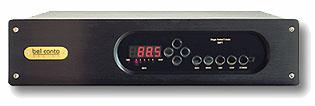
成色很新,状态完美,原装摇控器,价格9600 厦门特维音响小叶 13806036150 QQ 496781131 Bel Canto Design SEP1 Line-Stage Preamp
by Jeff Fritz | Review at a Glance| Sound | Does vocals very right in the process of reproducing music with the majesty of tubes; images are palpable; the midbass and lower bass have tube weight and bloom. |
| | Features | RCA and XLR inputs and outputs; remote control of volume, balance and input selection; room for expansion/upgrades, including a phono stage or DAC. |
| | Use | Front-panel controls are intuitively arranged; XLR inputs are truly balanced, but circuitry and outputs are not. |
| | Value | Tubed line-stage preamps with modern features, multiple types of inputs and outputs, and an under-$4k price tag are not plentiful, but the SEP1 is one -- of few. |
|
|
|
Audiophiles have a right to expect as few compromises as possible in the equipment they purchase. Sound quality, features, upgradeability, and reliability are but a few of the areas in which we scrutinize the gear we buy. The computer age has taught us about obsolescence and value; prices have plummeted, and performance is greater than ever before. We increasingly use the computer model for the selection of high-end audio equipment. We want it all, for as little as possible. Manufacturers have to address this very issue when designing equipment. Customers and dealers alike press the designer to include everything. As the other components in the system improve, or tastes change, that purchase must be adaptable. As new standards are adopted and recording techniques refined, that component must keep pace. And above all else, the sound must transport us to the musical event. Quite the challenge. Bel Canto Designs has accepted that challenge and stands ready to give us just about everything in their SEP1 line-stage preamp. My initial excitement, in fact, centered on the flexibility of the unit itself. Everything on my wish list was there: remote control, XLR inputs and outputs, a pass-through input; even a digital volume readout (good for reviewers) was included in this single-ended triode preamplifier. I must confess that one part of me kept wondering: "How can they put all of those things in and get good sound out of it?" Give us everything we ask for, and then we get skeptical. You just can’t please some folks. Description
The SEP1 is a unique-looking, yet attractive piece of gear. The unit itself is housed in a heavy-gauge, folded steel chassis, with a thick aluminum faceplate. The top cover attaches to the base with six counter-sunk, Phillips-head screws. The faceplate is anodized black with a contrasting gold Bel Canto name badge affixed to the left side. To the right is an oblong window that contains all front-mounted controls with accompanying LEDs, and the digital volume readout. The volume display is easily readable from across the room as well as at severe angles. Volume, balance, mute and source can be adjusted from the front panel via large silver-colored buttons. Ergonomically, this arrangement is well thought out, with nice touches such as the diamond pattern volume/balance layout. Whether up, down, left, or right, the corresponding button attenuates in that direction. The rear panel is packed with high-quality connectors. Bel Canto uses some of the best RCAs I’ve seen, along with Neutrik XLRs. Two sets of each are supplied for standard inputs along with a tape loop and a pass-through input for an external processor. In this mode, the volume control of the SEP1 is bypassed, using the processor’s own volume exclusively. For a purist who enjoys home theater as well as music, this is the ideal configuration. When listening to two-channel music, all surround equipment is avoided. There is also a punch out "bay" for the addition of an internal phono stage ($1450) or 24-bit/96kHz upsampling DAC with slow roll-off filter ($1295). When we want it all -- we want expandability and forward thinking. A small plastic remote is supplied for control of volume, mute, balance, input selection, and standby. Although the remote performed flawlessly, its build is not quite up to the SEP1’s standard. A detachable IEC power cord is also provided. Removing the top cover of a review piece can be akin to seeing your favorite supermodel without make-up. The layers of cosmetic fluff are removed, and we come away with one of two opinions: "Wow, she really is beautiful" or "My, that’s some good make-up." Fortunately for Bel Canto owners, the former is most appropriate. The internal layout is clean and well-organized. Solder joints are plump and healthy, and parts quality is high. Hovland Musicaps and a large e-core transformer stand out, along with generous supply capacitance. Two 6DJ8/6922 triodes are mounted in the center of the circuit board. The circuit itself is a zero-loop-feedback, single-ended-triode design. This reportedly provides plenty of gain with minimal noise, along with low output impedance for good load drive. The power supply uses a separate current-source-driven shunt regulator in each channel. This offers isolation and stability similar to that of a battery power supply. A Crystal 3310 stepped analog attenuator is coupled with a micro-controller for volume duties. Although XLR inputs and outputs are provided, only the inputs are truly balanced, and the circuit itself is cited as being single-ended. The thought here is that the advantages of balanced cables and their inherent properties are preferable to RCAs. According to Bel Canto, however, the additional parts and signal processing necessary for a fully balanced circuit would degrade the otherwise simplistic design of the SEP1. Gain, both at the single-ended and XLR outputs, is rated at 16dB. Maximum output level is 20 volts RMS. Output impedance is 150 ohms, while input impedance is 20k ohms for the RCAs and 35k ohms for the XLR inputs. Bandwidth is claimed to be a very wide 2Hz to 800kHz. Operation The SEP1 was designed to idle in "warm standby" when not in use. In this mode, tubes are relieved of high voltage while all circuits are kept warm. This reportedly ensures thermal stability and extends the life of the unit. Once power is engaged, the SEP1 switches from standby to mute, where it remains for approximately 20 seconds. The system is fully operable when "60" appears on the volume display. This is the default setting in a range from 0 to 100 accomplished via .5 dB steps. Bel Canto recommends 200 to 300 hours of break in before the unit sounds its best. The review sample had been thoroughly broken in before shipment, although continued improvements were noted throughout the first week. Review system The single-ended inputs were used with my primary source, a Pioneer DVD player. A second input was used with the front left/right outputs of a Dolby Digital processor. The pass-through input was not tested. A Mark Levinson 335 was driven by the SEP1 using the XLR outputs. All cabling throughout the system was from Transparent Audio, with the exception of one set of Apature RCAs with locking WBT connectors. The WBTs mated well with the beefy RCAs on the SEP1. Speakers were the Wilson X-1 Grand SLAMM Series II (review forthcoming). Power conditioning was provided by the Bybee Pro Power Purifier. A dedicated 30-amp line fed the amplifier while a 20-amp line was used for everything else. My listening room is 18'L x 14'W with no windows. Side walls are treated with an absorbent material for the taming of first reflections, with a similar panel covering the wall behind the listening position. The preamplifier referenced directly before the review period was a Proceed Pre. It’s important to establish a reference point, for it is then easier to describe any deviation from that point. Sound I must admit to having some (positive) preconceptions about the sound of a SET preamplifier. I therefore listened to quite a bit of vocal music initially upon installing the SEP1 into my system. This turned out to be a great place to start, as the SEP1’s midrange is truly stunning. Male vocals gained body and substance. A slight leanness on some recordings was replaced with a warm, cozy, more intimate quality throughout the midband. This is not to say that vocals were moved forward or presented with unnatural size. However, they were more palpable and three-dimensional. Harry Connick Jr’s "Between Us" from his She CD [Columbia CK 64376] illustrates the SEP1’s ability to render male vocals with a tonally rich character while maintaining a realistic presentation. I did not find this rich quality necessarily colored; in fact, it seemed more natural to me. It was as if more information were being communicated about the quality and tone of the voice itself. Resolution is not just about detail and ambient cues. It’s about the accurate portrayal of all tonal characteristics as well. The midrange of the SEP1 gave me the qualities I find satisfying in this frequency range. The upper midrange and its transition into the high frequencies was rewarding as well. The SEP1 faithfully reproduced all types of stringed instruments as well as female voice. Sarah McLachlan’s voice on "Angel" from her Surfacing CD [Arista 07822-18970-2] gained a presence that made the illusion of the performance more real. The upper range did not seem rolled or blunted. It was actually quite detailed and with full extension, perhaps a byproduct of the SEP1’s wide-bandwidth design. Unfortunately, the SEP1’s noise floor did hamper low-level resolution. This was rarely a problem at what I would consider "normal" listening levels. In fact, unless you are accustomed to nearfield listening at very soft levels, you probably won’t notice any problem. With all the SEP1 does right, the slight added noise, indicative of many tube preamps, seems like a fair trade-off. The midbass down to the lower bass was reproduced with a sense of weight that was welcome on most recordings. I would describe it as ripe and full but short of outright bloated. Again, a tonally pleasing sound was heard. Bass, kick drum, and organ were reproduced with full impact and weight. The tonal character of these instruments came through in a wholly believable way. Paula Cole's "Tiger" from This Fire [Warner Bros. 9 46424-2] was deep and powerful. I heard no indication of a truncated low end. In fact, this attribute will likely enhance the performance of a lean system. At one point, I considered placing my speakers an inch or two further forward to restore the previous balance. I then decided that my solid-state preamp might be slightly dry, highlighting the full, ripe quality of the Bel Canto. Absolute neutrality probably lies somewhere in between the two. The soundstage was rendered naturally and with good lateral focus. Depth was excellent, owing much to the palpable images created by the SEP1. Tracks with an unnaturally large soundstage came through impressively so. Sophia B Hawkins’ "As I Lay Me Down" from her Whaler CD [Columbia CK 53300] is a good example. The vocalist sounds much like the proverbial 50-foot woman. Although not at all realistic, this music is enjoyable to listen to as it envelops the entire room. The SEP1 reproduced large-scale music with the authority and majesty it requires. Its excellent extension at both frequency extremes leaves little to the imagination. Imaging, however, is not quite pinpoint accurate the way some audiophiles expect. It took me some time to realize that if a vocal appears to come from a tiny point in space, this is not necessarily correct. The dispersion of a human voice conveys more information, which includes depth and substance. You’re not just hearing a mouth, but an entire body projecting forth. The SEP1 is very good at creating this illusion. In fact, when you find that perfect volume for a given recording, the Bel Canto will give you an eerie sense of vocal presence. Comparison Direct comparisons were made with the Proceed Pre. This solid-state unit is significantly dryer and cooler in its presentation compared with the tubed SEP1 -- no surprise. It doesn’t sound as tonally rich, and images have less substance. The Proceed does excel in the low bass, however. Its low end is tighter and punchier than with the SEP1. The Bel Canto does seem to extend as low, however. The Proceed’s sound is complemented by its extremely low noise floor. This is one area where it significantly betters its tubed adversary. As I’ve stated, lean systems will likely be complemented by the Bel Canto. In addition, bright speakers may find a mate with the SEP1 too. Its bloom in the lower midrange/upper bass strikes a pleasant balance with the extended treble. Reproduction of the entire vocal range was clearly superior with the SEP1. More tonal information was present, as voices simply sounded more real. The Proceed’s depiction of depth and substance, although good, is not quite the match for the SEP1’s remarkable performance in this area. The quality of construction of both the Proceed and the Bel Canto preamps is first-rate. The SEP1 does have superior connectors and a heftier chassis. Remote-control facilities are more generous with the Proceed. Features are similar, although the Proceed is not upgradeable in the same way the SEP1 is. Conclusion My overall opinion of the Bel Canto SEP1 is very positive. It will provide its owner with a pleasing re-creation of all types of music, especially vocals. Its thoroughly modern design shows Bel Canto’s commitment to please its customers; and the ability to upgrade the unit, should enhancements become available, also increases its value. Those who seek a tonally rich, full sound will likely find the SEP1 very much to their liking. Sins are generally of omission, while the positive attributes of this unit stand proud. If you’re looking for the type of sound I’ve described along with excellent build and generous features, you may have found it all in the SEP1. ...Jeff Fritz
www.belcantodesign.com
[/td][/tr]
[/table]FD


|  京公网安备 11010602010207号
( 京ICP证041102号,京ICP备09075138号-9 )
京公网安备 11010602010207号
( 京ICP证041102号,京ICP备09075138号-9 )







 狗仔卡
狗仔卡

 发表于 2013-5-20 14:56

 变色卡
变色卡 楼主
楼主





 发表于 2013-8-6 19:44



